




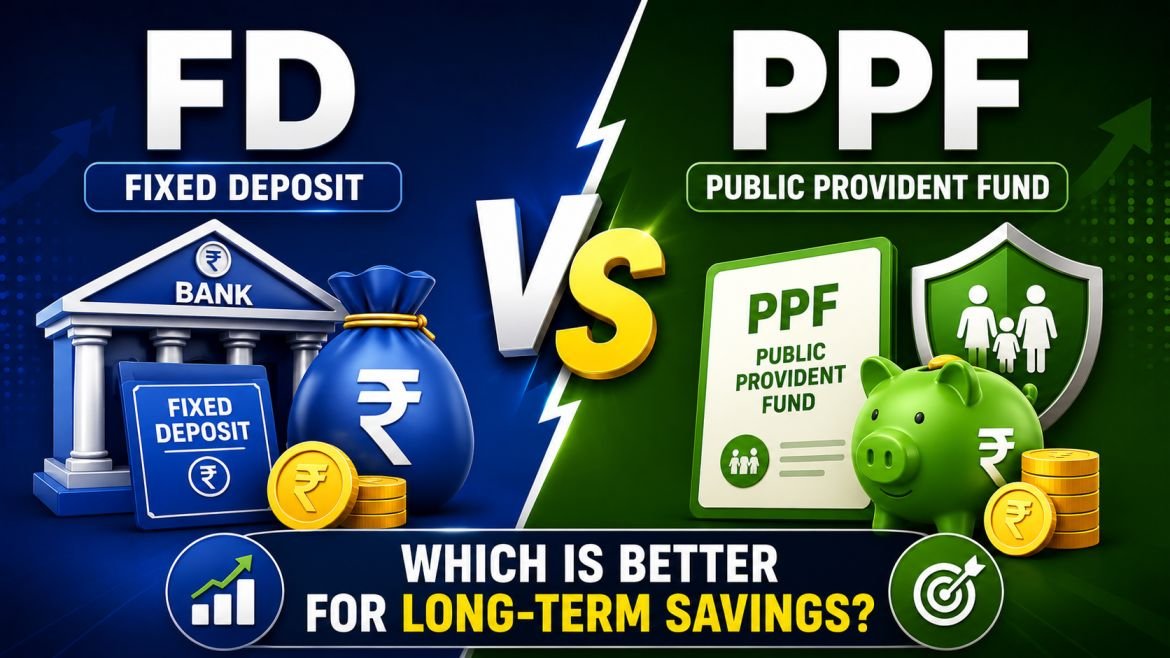
Key takeaways
- An FD is flexible and available at any bank; PPF is a 15-year government-backed scheme with a fixed annual contribution limit
- PPF interest is completely tax-free; FD interest is fully taxable at your income slab rate
- For taxpayers in higher slabs, PPF's tax-free return often beats an FD's post-tax return even when the FD's headline rate looks similar or higher
- PPF has a maximum contribution of ₹1.5 lakh per financial year; an FD has no such cap
- FDs suit short-to-medium term goals and emergency-adjacent savings; PPF suits long-term, retirement-horizon goals
Quick answer
Saving for something 1-5 years away, or want flexibility: an FD fits better — no annual contribution cap, and a range of tenures to match your timeline.
Saving for a goal 10+ years away, especially retirement: PPF's tax-free compounding usually wins, particularly if you're in a higher tax bracket.
The core difference
A fixed deposit is a bank product — you deposit a lump sum for a tenure you choose, and the bank pays a fixed interest rate for that period. It's flexible: available at any bank, tenures from days to years, and no cap on how much you can deposit.
PPF (Public Provident Fund) is a government-backed savings scheme with a fixed 15-year tenure, a government-set interest rate revised quarterly, and a maximum contribution of ₹1.5 lakh per financial year (minimum ₹500). In exchange for the longer lock-in and lower annual limit, PPF offers something an FD can't: completely tax-free interest.
The comparison isn't just about the headline rate. FD interest is added to your income and taxed at your slab rate — for someone in a higher tax bracket, a meaningful chunk of the FD's return disappears in tax. PPF interest is entirely tax-free, so its real, in-hand return can end up higher than an FD even when the stated rate looks similar or lower.
Why the tax treatment matters so much
PPF falls under the "Exempt-Exempt-Exempt" (EEE) tax category — your contribution qualifies for a deduction under Section 80C, the interest earned is tax-free every year, and the maturity amount is tax-free too. An FD has no equivalent status: only the principal (if it's a tax-saving FD with a 5-year lock-in) may qualify for a limited 80C deduction, and the interest is always taxable.
Try the PPF Calculator
See what 15 years of PPF contributions could grow into, tax-free.
The tax gap, with actual numbers
Ananya, in the 30% tax bracket, contributes the maximum ₹1.5 lakh a year to both scenarios for comparison. At an illustrative PPF rate of 7.1%, fully tax-free, her contributions grow to roughly ₹40 lakh over 15 years.
If she'd instead put that same ₹1.5 lakh a year into an FD at a slightly higher illustrative rate of 7.5%, but paid 30% tax on the interest every year, her effective post-tax return drops to around 5.25% — and the same 15 years of contributions would grow to only about ₹34-35 lakh.
Same annual amount, similar-looking headline rates, but roughly a ₹5-6 lakh gap over 15 years — purely because of how the interest is taxed. This is exactly why Ananya maxes out her PPF contribution every year before considering a long-term FD.
Rohit has ₹6 lakh in surplus business cash that he expects to need for an equipment upgrade in about a year and a half. PPF's 15-year lock-in doesn't fit that timeline at all — even the earliest loan-against-PPF window only opens in year 3. He puts the money into an 18-month FD instead, accepting the fully taxable interest in exchange for having the money back exactly when he needs it.
✅ Ananya and Rohit aren't making different choices because one of them is "wrong" — Ananya's money genuinely has 15 years to work, Rohit's doesn't. The tax-free PPF advantage only matters if you can actually let the money sit that long.
Side-by-side comparison
| Feature | Fixed deposit (FD) | PPF |
|---|---|---|
| Tenure | Flexible — days to years, your choice | Fixed 15 years (extendable in 5-year blocks after maturity) |
| Maximum contribution | No cap | ₹1.5 lakh per financial year |
| Minimum contribution | Varies by bank, usually low | ₹500 per financial year |
| Interest taxation | Fully taxable at your slab rate | Completely tax-free |
| Section 80C benefit | Only on 5-year tax-saving FDs, principal only | Yes, on the full contribution up to ₹1.5 lakh/year |
| Liquidity | Breakable anytime, with a penalty on interest | Loan available years 3-6; partial withdrawal from year 7; premature closure after 5 years only for specific reasons |
| Risk | Very low, insured up to the deposit insurance limit per bank | Sovereign-backed, effectively zero credit risk |
Common mistakes to avoid
Common mistake: comparing FD and PPF purely on the headline interest rate, ignoring tax. As Ananya's example above shows, a PPF rate that looks lower than an FD's can still deliver a higher post-tax return, especially for someone in the 20-30% tax bracket.
- Contributing to PPF without a clear multi-year commitment, then needing the money before the loan/withdrawal windows open — the exact situation Rohit avoided by choosing an FD instead
- Missing the minimum ₹500 annual PPF contribution, which can make the account inactive until it's regularised with a penalty
- Not using PPF's 80C benefit alongside other 80C instruments, potentially exceeding the combined ₹1.5 lakh limit unnecessarily across products — our Section 80C guide covers how to use the full limit intelligently
- Breaking an FD early without checking the interest penalty, when a shorter-tenure FD chosen upfront might have avoided it
Myths vs facts
| Myth | Fact |
|---|---|
| A higher FD rate always beats PPF | Once tax is factored in, PPF's tax-free return can exceed an FD's post-tax return, especially for higher tax bracket investors — as Ananya's ₹5-6 lakh gap above shows |
| PPF money is completely locked for 15 years with zero access | PPF allows a loan against the balance in years 3-6 and partial withdrawals from year 7 onward, plus premature closure after 5 years for specific reasons like medical treatment or higher education |
| You can only choose one — FD or PPF | Most people benefit from both — an FD for near-term flexibility like Rohit's, PPF for long-term, tax-free compounding like Ananya's |
Best practices
- Use PPF for goals genuinely 10+ years away, especially retirement, to make full use of the tax-free compounding
- Keep shorter-term savings and your emergency-adjacent buffer in FDs, where you can choose a tenure that matches your actual timeline — see our savings account vs FD guide for how to split money between instant-access and FD savings
- Contribute to PPF early in the financial year (rather than in March) so that year's contribution earns interest for longer
- If you're a higher tax bracket earner, prioritise maxing out PPF's ₹1.5 lakh annual limit before parking additional long-term money in FDs
- If you're weighing PPF against your EPF too, our PPF vs EPF guide covers how the two work together for retirement
Frequently asked questions
Is PPF really better than FD for everyone?
Not for everyone — it depends on your time horizon and tax bracket, as Ananya's and Rohit's examples above show. For long-term goals and higher tax brackets, PPF's tax-free return usually wins. For short-term needs or if you need to contribute more than ₹1.5 lakh a year to a single instrument, an FD is more practical.
What is the maximum I can invest in PPF each year?
₹1.5 lakh per financial year is the maximum. Deposits beyond this limit don't earn interest and aren't eligible for the Section 80C deduction.
Can I withdraw from my PPF account before 15 years?
Yes, in limited ways: a loan against your balance is available between the 3rd and 6th financial years, and partial withdrawals are allowed from the 7th financial year onward. Full premature closure is allowed only after 5 financial years, and only for specific reasons like the account holder's serious medical treatment, higher education needs, or a change in residency status, typically with a reduction in the interest rate applied. Our PPF withdrawal rules guide covers every option in detail.
Is FD interest always taxed, even if I reinvest it?
Yes, FD interest is taxable in the year it accrues (or is paid, depending on the FD type), regardless of whether you reinvest it or withdraw it, and banks deduct TDS once interest crosses the prescribed threshold in a financial year.
Can I open more than one PPF account?
No, an individual can hold only one PPF account in their own name (a separate account can be opened for a minor child, operated by the guardian).
What happens to my PPF account after 15 years?
You can withdraw the entire tax-free balance, or extend the account in blocks of 5 years, either continuing to contribute or simply letting the existing balance keep earning interest without fresh contributions.
Does a tax-saving FD offer the same tax benefit as PPF?
Only partially — a 5-year tax-saving FD's principal qualifies for a Section 80C deduction, similar to PPF, but the interest earned on a tax-saving FD is still fully taxable, unlike PPF's completely tax-free interest.
Which is safer, FD or PPF?
Both are considered very low-risk. Bank FDs are covered by deposit insurance up to a set limit per depositor per bank, while PPF is a sovereign-backed government scheme, generally considered to carry effectively zero credit risk.
Can I take a loan against my PPF balance?
Yes, a loan facility is available against your PPF balance between the 3rd and 6th financial years of the account, offering liquidity without needing to withdraw or break the account.
Is the interest rate the same for FD and PPF?
No, they're set independently — FD rates vary by bank and tenure, while the PPF rate is set by the government and revised quarterly, applying uniformly across all PPF accounts regardless of which bank or post office holds them.
How much does tax actually cost me on an FD compared to PPF?
It depends on your tax bracket, but as a rough illustration, a taxpayer in the 30% bracket contributing ₹1.5 lakh a year for 15 years could see roughly ₹5-6 lakh less in their final FD corpus compared to an equivalent PPF contribution, purely due to annual tax on the FD interest, as shown in the worked example above.