




Key takeaways
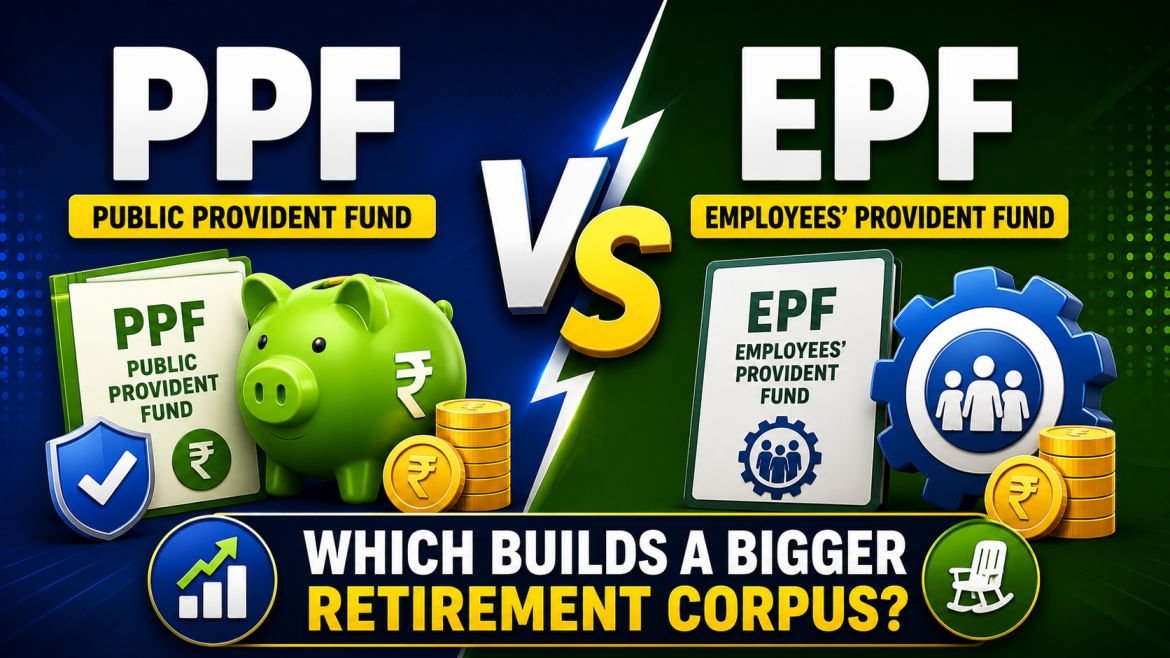
- EPF is a salaried-employee retirement scheme with mandatory employer + employee contributions; PPF is voluntary and open to anyone, salaried or not
- Both offer tax-free interest and fall under the EEE tax category, but their contribution structures work very differently
- EPF contributions are a fixed percentage of basic salary (split between employee and employer); PPF has a flat annual cap of ₹1.5 lakh regardless of income
- EPF is tied to your employment; PPF continues independently of any job change or career break
- Many salaried people benefit from having both — EPF happens automatically through payroll, while PPF adds a separate, flexible tax-free layer on top
Quick answer
You're a salaried employee: your EPF contribution is likely already happening automatically through payroll — no action needed there, but consider also opening a PPF account for extra tax-free savings beyond EPF's structure.
You're self-employed, a freelancer, or not in EPF-covered employment: PPF is your equivalent long-term, tax-free retirement savings vehicle, since EPF isn't available to you directly.
The core difference
EPF (Employees' Provident Fund) is a mandatory retirement savings scheme for salaried employees at eligible organisations, administered by the EPFO. Both the employee and employer contribute a fixed percentage of the employee's basic salary (plus dearness allowance) every month, and the accumulated balance earns interest declared annually by the EPFO.
PPF (Public Provident Fund) is a voluntary scheme open to any resident individual — salaried, self-employed, or not working at all. You choose how much to contribute each year (₹500 to ₹1.5 lakh), and there's no employer counterpart contribution.
The key structural difference: EPF is employment-linked and largely automatic once you're on a company's payroll; PPF is entirely your own choice, open to everyone, with a fixed annual ceiling that has nothing to do with your salary.
How contributions work
- EPF: both employee and employer contribute a percentage of basic salary each month; part of the employer's contribution typically also goes toward a linked pension scheme (EPS) rather than the EPF account itself
- PPF: the account holder alone decides the contribution amount each financial year, anywhere from ₹500 to ₹1.5 lakh, with no employer involvement
Try the PPF Calculator
See how a PPF contribution on top of EPF could grow your total retirement corpus.
How this plays out with real numbers
Ananya earns a basic salary of ₹50,000/month. Her EPF contribution — 12% from her, matched by her employer — works out to ₹6,000/month from her own side, deducted automatically before she even sees the money. Over 25 years at a typical EPF rate, that steady, forced saving alone builds into a substantial retirement base, without her ever having to make an active decision about it.
On top of that, Ananya separately contributes ₹1.5 lakh a year to a PPF account she opened herself — money she has to actively choose to set aside, since nobody deducts it for her. Over the same horizon, this second pool compounds independently, fully tax-free like her EPF, giving her two separate retirement buckets instead of relying on EPF alone.
Priya, a freelance graphic designer, has never had an employer, so she's never had an EPF account. Without PPF, she'd have no tax-free, government-backed long-term savings vehicle at all — her retirement planning would rely entirely on taxable instruments or market-linked investments with no EEE tax status.
She contributes ₹1 lakh a year to PPF, as much as her variable freelance income comfortably allows. It isn't the full ₹1.5 lakh ceiling, but for Priya, PPF isn't a supplementary layer the way it is for Ananya — it's doing the entire job that EPF does automatically for salaried employees.
✅ Same PPF mechanics, two very different roles: for Ananya, it's an addition on top of EPF's automatic base. For Priya, it's carrying the full weight of what EPF would otherwise be doing.
Side-by-side comparison
| Feature | EPF | PPF |
|---|---|---|
| Who can open one | Salaried employees at EPF-covered organisations | Any resident individual |
| Contribution | Fixed % of basic salary, employee + employer | Voluntary, ₹500 to ₹1.5 lakh per year |
| Administered by | EPFO | Post offices and authorised banks, under government rules |
| Tax treatment | EEE (broadly tax-free), subject to continuous service conditions | EEE — fully tax-free at every stage |
| Tied to employment | Yes | No — continues regardless of job changes |
| Withdrawal on job change | Can be transferred to new employer or withdrawn under conditions | Unaffected by any job change |
If you're weighing a third option too: NPS is the other major retirement instrument worth comparing alongside EPF and PPF, particularly for its additional ₹50,000 tax deduction under Section 80CCD(1B). Our full NPS vs EPF vs PPF comparison covers how all three actually work together.
Common mistakes to avoid
Common mistake: withdrawing the EPF balance entirely when changing jobs, instead of transferring it. Frequent withdrawals before completing the continuous service period required for tax-free treatment can trigger unnecessary tax and interrupt long-term compounding.
- Assuming EPF alone is enough for retirement without checking whether the accumulated corpus actually matches your retirement income needs — as Ananya's example above shows, a second layer like PPF fills a real gap
- Not opening a PPF account simply because EPF is already happening automatically — the two serve complementary, not overlapping, purposes
- Forgetting to update or link EPF accounts across job changes, leading to multiple dormant EPF accounts instead of one consolidated balance
- Ignoring PPF because of its lock-in, without accounting for the loan and partial withdrawal options available in the later years — see our PPF withdrawal rules guide for exactly how and when these open up
Myths vs facts
| Myth | Fact |
|---|---|
| EPF and PPF are basically the same thing | They're structurally different — EPF is mandatory and employment-linked with employer contributions, while PPF is voluntary and open to anyone, as Ananya's and Priya's very different situations above show |
| You can't have both EPF and PPF at the same time | You can hold both simultaneously — many salaried individuals, like Ananya, do exactly this to build a larger tax-free retirement corpus |
| Withdrawing EPF when switching jobs is the simplest option | Transferring the balance to your new employer's EPF account is usually better, preserving continuity for tax-free treatment and uninterrupted compounding |
Best practices
- Transfer, don't withdraw, your EPF balance when changing jobs, unless there's a genuine, unavoidable need for the funds
- If you're salaried, consider opening a PPF account alongside your EPF for an additional tax-free savings layer, the way Ananya does
- If you're self-employed or freelance, treat PPF as your primary long-term, tax-free retirement vehicle in the absence of EPF, as Priya does
- Periodically check your EPF balance and account consolidation status through the EPFO's official portal
- Both EPF and PPF contributions count toward your combined Section 80C limit — see our Section 80C guide for how to use the full ₹1.5 lakh limit across instruments without overlap
Frequently asked questions
Can I have both an EPF and a PPF account?
Yes, there's no restriction on holding both simultaneously. Many salaried individuals, like Ananya in the example above, contribute to EPF automatically through payroll while also maintaining a separate PPF account for additional tax-free savings.
Is EPF withdrawal always tax-free?
Generally, EPF withdrawal is tax-free if the employee has completed a continuous specified period of service; withdrawals before that period can attract tax, subject to certain exceptions.
What happens to my EPF if I become self-employed?
Your existing EPF balance continues to earn interest for a period even without fresh contributions, though you should check current EPFO rules on inactive accounts. PPF becomes your practical ongoing option, since EPF requires an employer contribution structure — exactly the situation Priya is in above.
Does the employer's EPF contribution go entirely into my EPF account?
Not entirely — a portion of the employer's contribution is typically diverted to the Employees' Pension Scheme (EPS), a separate linked pension fund, rather than the EPF account balance itself.
Can I contribute more than the mandatory EPF percentage?
Yes, through the Voluntary Provident Fund (VPF), an extension of EPF that lets employees contribute beyond the mandatory percentage, generally earning the same interest rate as EPF.
Is PPF a good substitute for EPF if I'm not salaried?
Yes, PPF is one of the most practical tax-free, long-term savings options available to self-employed individuals and freelancers who don't have access to EPF — as it is for Priya in the example above.
What happens to my EPF account if I don't transfer it after changing jobs?
It remains on record with the EPFO and can still be transferred later, though leaving multiple untransferred accounts across employers makes tracking your total retirement corpus more cumbersome than consolidating them.
Can I withdraw my EPF partially before retirement?
Yes, EPFO allows partial withdrawals for specific purposes such as home purchase, medical treatment, or education, subject to conditions and minimum service requirements that vary by purpose.
Is PPF interest higher than EPF interest?
The rates are set independently and can differ from year to year — sometimes EPF's declared rate is higher, sometimes PPF's is, since each is reviewed on its own schedule by the respective authority.
Do both EPF and PPF qualify for Section 80C?
Yes, both the employee's EPF contribution and PPF contributions qualify for deduction under Section 80C, subject to the combined overall limit across all your 80C investments in a financial year.
Should I also consider NPS alongside EPF and PPF?
It's worth looking at, particularly for the additional ₹50,000 deduction under Section 80CCD(1B) that neither EPF nor PPF offers. Our NPS vs EPF vs PPF guide covers how all three can work together rather than as exclusive choices.