




Key takeaways
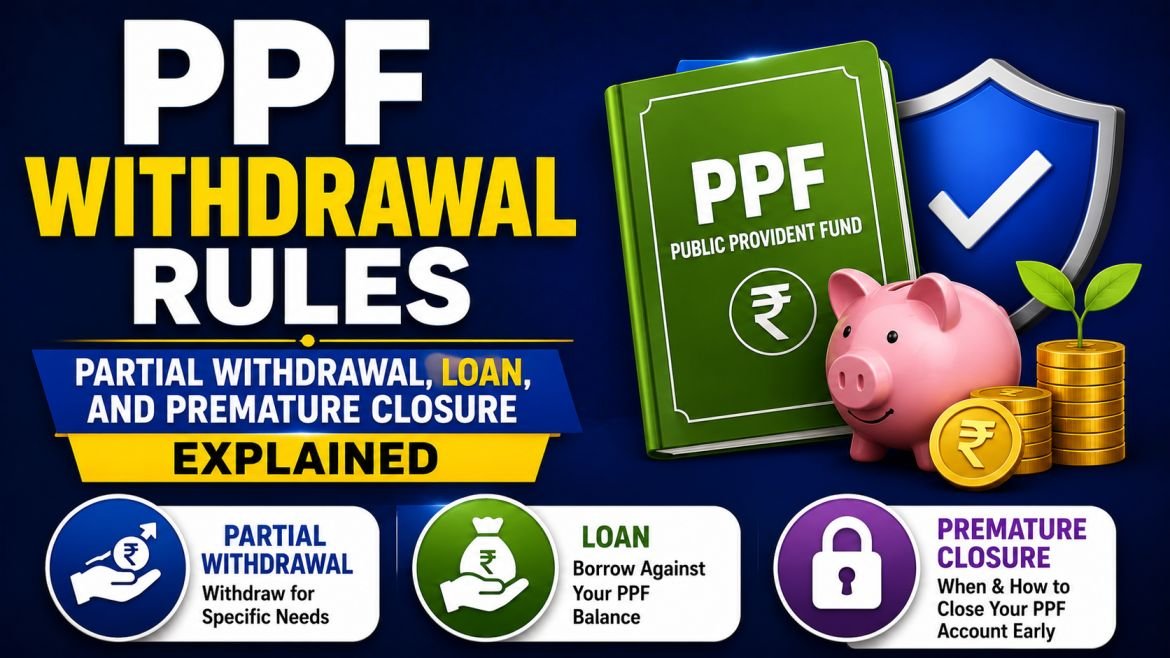
- PPF has three separate ways to access money before the full 15-year maturity: a loan, a partial withdrawal, and premature closure — each opens up at a different point in the account's life
- No withdrawal of any kind is possible in the first few years — the account is fully locked initially
- A loan against your PPF balance is available between the 3rd and 6th financial years
- Partial withdrawal opens up from the 7th financial year onward, capped at 50% of the lower of two specific reference-year balances
- Full premature closure is allowed only after 5 financial years, for specific reasons only, and comes with a 1% reduction in the interest rate applied to the account
- If you extend your account after 15 years with fresh contributions, you can withdraw up to 60% of the balance at the start of that extension block; extending without contributions allows one uncapped withdrawal per year instead
Quick answer
Need short-term liquidity in years 3-6 of your account: a loan against your PPF balance is usually the better option, since it doesn't disturb your compounding balance.
Your account is 7+ years old and you need funds for a specific need: a partial withdrawal is available, though it does reduce your long-term compounding base.
The three ways to access PPF money early
PPF's 15-year lock-in is genuinely long, but it isn't absolute. Three distinct mechanisms exist, each becoming available at a different stage:
| Route | When it opens up | What it does |
|---|---|---|
| Loan against PPF | 3rd to 6th financial year | Borrow against your balance without withdrawing it — the account keeps compounding |
| Partial withdrawal | 7th financial year onward | Withdraw a portion of your balance, permanently reducing what's left to compound |
| Premature closure | After 5 completed financial years, specific reasons only | Close the account entirely and withdraw the full balance, with a 1% interest penalty |
1. Loan against your PPF balance (years 3-6)
Between the start of the 3rd financial year and the end of the 6th financial year after opening your account, you can take a loan against your PPF balance rather than withdrawing from it directly. This keeps your full balance intact and compounding, while still giving you access to funds when needed — useful for short-term needs where you'd rather not permanently reduce your long-term PPF corpus.
Try the PPF Calculator
See how a partial withdrawal in a given year would affect your PPF corpus at maturity.
2. Partial withdrawal (from the 7th financial year)
From the 7th financial year of the account onward, you can make one partial withdrawal per year. This effectively means once 5 full financial years have passed since the account was opened (not counting the opening year), you're eligible.
How the maximum amount is actually calculated: your withdrawal limit is capped at 50% of the lower of two figures — your balance at the end of the 4th financial year immediately preceding the year of withdrawal, or your balance at the end of the previous financial year. This two-reference-point rule is what prevents the limit from being simply "50% of whatever's in the account right now," and it's why the exact number is worth confirming with your bank or post office rather than estimating from your current balance alone.
A partial withdrawal permanently reduces your compounding base. Unlike a loan, which you repay and which leaves your PPF balance untouched throughout, a partial withdrawal takes money out of the account for good — that amount no longer earns PPF's tax-free interest going forward. It's worth weighing a loan first if the need is genuinely short-term.
3. Premature closure (after 5 years, specific reasons only)
Closing the account entirely before the 15-year maturity is allowed only after completing 5 financial years, and only for specific, documented reasons:
- Serious medical treatment of the account holder, spouse, children, or dependent parents
- Higher education expenses of the account holder or a dependent child, against confirmed admission
- A change in the account holder's residency status (becoming an NRI)
Premature closure isn't available simply for general financial need — it's restricted to these specific, documented circumstances.
The penalty is specific: a 1% interest reduction. If you close your account prematurely, the interest rate applied to your entire balance — retroactively, from the date the account was opened or last extended — drops by 1 percentage point from whatever rate was actually credited over the years. So if your account earned an average of 7.1% over its life, premature closure recalculates it at 6.1% instead. This is deducted from your final payout, meaning you get back less than the passbook balance shown before closure.
What happens at the full 15-year maturity
At maturity, you have two choices: withdraw the entire balance (fully tax-free), or extend the account in blocks of 5 years.
If you extend with fresh contributions
You continue depositing into the account as before. During this extension block, you're allowed to withdraw up to 60% of the balance you had at the start of that 5-year extension, with one withdrawal permitted per financial year during the block.
If you extend without fresh contributions
You stop depositing, but let the existing balance continue earning interest. In this case, you're allowed one withdrawal per financial year, without the 60% cap that applies to the with-contribution option — since you're no longer actively growing the account, the scheme is more flexible about how much you take out at a time.
Worth deciding actively, not by default. If you don't formally choose to withdraw or extend at maturity, it's best to confirm with your bank or post office how your account will be treated, rather than assuming it continues exactly as before with no changes.
How this plays out in real life
Ananya's PPF account is in its 4th year when she needs funds for a short-term expense. She takes a loan against her PPF balance rather than a partial withdrawal, since her account isn't yet eligible for withdrawal and a loan keeps her full balance compounding.
Rohit's PPF account is in its 9th year when his daughter gets college admission. He makes a partial withdrawal to help cover the fees, accepting the reduced future compounding in exchange for meeting a genuine, planned need — and confirms the exact withdrawable amount with his bank first, since it's based on his balance from a specific earlier year, not his current balance.
Priya's PPF account is in its 6th year when she accepts a long-term overseas role and becomes an NRI. She's eligible for premature closure specifically because of this residency change, one of the narrow permitted reasons — and factors in the 1% interest reduction when deciding whether closing now versus waiting makes more sense for her situation.
Karan's PPF account reaches its 15-year maturity. He extends it in a 5-year block and continues contributing, since he doesn't need the funds yet and values the continued tax-free compounding — knowing that if he does need cash during this block, he can withdraw up to 60% of his balance at the start of the extension, once a year.
Mrs. Iyer's PPF account matures, and she extends it in a 5-year block but chooses not to add fresh contributions, simply letting her existing balance continue earning tax-free interest. Since she's not contributing further, she isn't bound by the 60% withdrawal cap either, and can draw what she needs each year, once annually, while she draws on other income sources.
Common mistakes to avoid
Common mistake: defaulting to a partial withdrawal when a loan against the balance would have met the same short-term need without permanently reducing the account's compounding base.
- Assuming any financial need qualifies for premature closure, when it's restricted to specific documented reasons only
- Not accounting for the full 1% interest penalty when planning around premature closure — it's a bigger hit than many expect once applied across the account's entire history
- Forgetting that only one partial withdrawal is allowed per financial year
- Assuming the partial withdrawal limit is simply "50% of my balance today" instead of the actual two-reference-year formula, which can result in a smaller-than-expected withdrawable amount
- Letting the account sit unclaimed well past the 15-year maturity without actively choosing to withdraw or formally extend it
Myths vs facts
| Myth | Fact |
|---|---|
| PPF money is completely inaccessible for 15 years | A loan is available from year 3, and partial withdrawals from year 7 — the account isn't as rigidly locked as many assume |
| You can close a PPF account early for any financial emergency | Premature closure is restricted to specific reasons — serious medical treatment, higher education, or a residency status change — not general financial need |
| A partial withdrawal and a loan have the same effect on your account | A loan is repaid and leaves your balance compounding throughout; a partial withdrawal permanently removes that amount from future compounding |
| You can withdraw as much as you like during a 5-year extension | If you're still contributing during the extension, withdrawals are capped at 60% of your balance at the start of that block — only extensions without fresh contributions skip this cap |
Best practices
- Prefer a loan over a partial withdrawal for genuinely short-term needs within years 3-6, to preserve your compounding base
- Plan larger, foreseeable expenses (like a child's education) around your partial withdrawal eligibility from year 7 onward, and confirm the exact withdrawable amount with your bank rather than estimating it yourself
- Keep documentation ready in advance if you anticipate needing premature closure for medical or education reasons, and factor the 1% interest penalty into your decision
- Decide actively at the 15-year mark — withdraw or formally extend, and choose with or without contributions based on whether you'll need flexible annual access
Frequently asked questions
Can I withdraw from my PPF account in the first few years?
No, no withdrawal of any kind is permitted in the early years of the account. The loan facility is the earliest access point, opening from the 3rd financial year.
What's the difference between a PPF loan and a partial withdrawal?
A loan is borrowed against your balance and repaid, leaving your full balance intact and compounding throughout. A partial withdrawal permanently removes money from the account, reducing what's left to earn interest going forward.
How much can I withdraw as a partial withdrawal?
The maximum is 50% of the lower of two figures: your balance at the end of the 4th financial year immediately preceding the withdrawal year, or your balance at the end of the previous financial year. It isn't simply half of your current balance — confirm the exact figure with your bank or post office before planning around it.
Can I close my PPF account early if I just need the money?
Not for general financial need. Premature closure after 5 years is restricted to specific reasons: serious medical treatment, higher education expenses, or a change in residency status to NRI.
Is there a penalty for premature closure?
Yes — a 1 percentage point reduction in the interest rate applied to the account, retroactive to the date it was opened or last extended. So an account that earned an average 7.1% would be recalculated at 6.1% for the purpose of the final payout, which noticeably lowers the overall return compared to holding it to full maturity.
Can I make more than one partial withdrawal in a year?
No, only one partial withdrawal is permitted per financial year once you're eligible from the 7th year onward.
What happens to my PPF account after the 15-year maturity if I do nothing?
It's best to actively choose to either withdraw the balance or formally extend the account in a 5-year block — leaving it without an active decision can complicate how it's treated, so check with your bank or post office if you're approaching maturity.
Can I extend my PPF account more than once after maturity?
Yes, extensions can generally be made in successive 5-year blocks, with the choice each time to continue contributing or simply let the existing balance keep earning interest.
How much can I withdraw if I extend my PPF account with fresh contributions?
Up to 60% of your balance at the start of that particular 5-year extension block, with one withdrawal allowed per financial year during the extension. If you extend without adding fresh contributions instead, this 60% cap doesn't apply, and you can withdraw once a year without that specific limit.
Do I need to repay a loan taken against my PPF balance?
Yes, a PPF loan needs to be repaid with interest within the specified repayment period set by the scheme's rules, similar in spirit to any other secured loan.
Is the amount withdrawn from PPF taxable?
No, withdrawals from PPF — whether partial, on premature closure, or at full maturity — are tax-free, consistent with PPF's overall EEE (Exempt-Exempt-Exempt) tax status.