




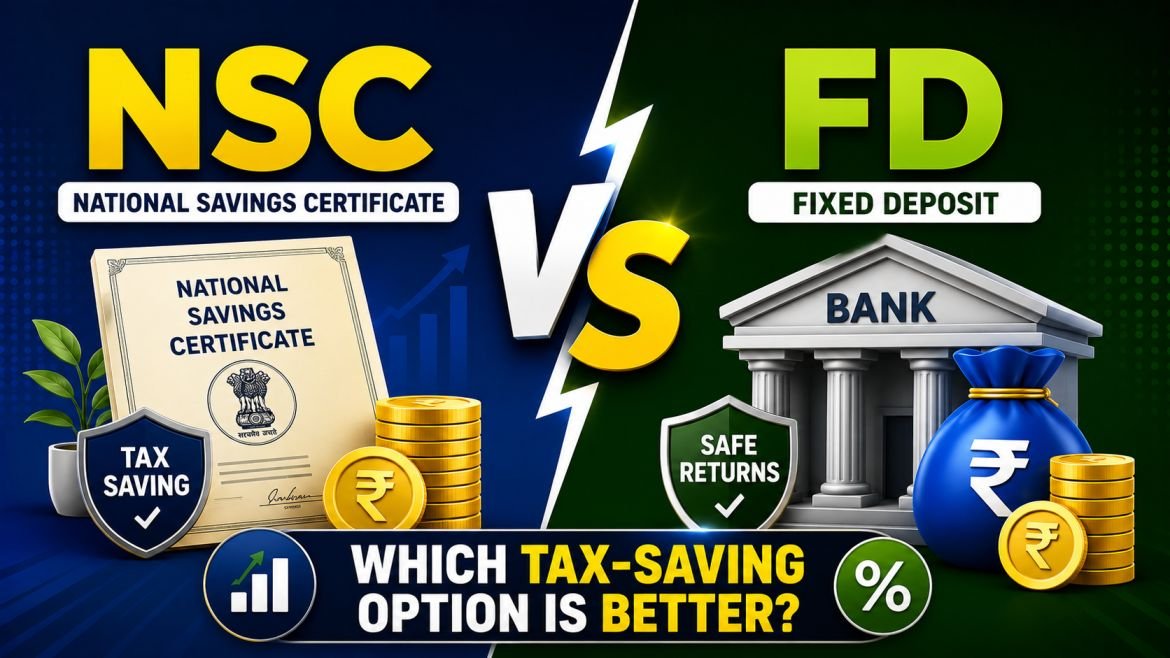
Key takeaways
- NSC (National Savings Certificate) has a fixed 5-year lock-in with no premature withdrawal except in narrow cases like death or a court order
- A tax-saving FD also has a 5-year lock-in, but ordinary FDs can be opened for any tenure with no such restriction
- NSC interest is reinvested each year and only paid out at maturity; most FDs let you choose payout frequency
- Both offer a Section 80C deduction on the principal (up to the overall 80C limit), but NSC additionally lets you claim a deduction on the reinvested interest for the first four years — a real, calculable tax saving an FD doesn't offer
- NSC has no TDS deducted by the post office, unlike bank FDs, though the interest is still fully taxable and must be declared
Quick answer
Want a tax-saving instrument with a predictable 5-year horizon and don't mind zero liquidity: NSC is a straightforward, government-backed option available at any post office.
Want more flexibility on tenure, payout frequency, or the ability to break the deposit if needed: an ordinary FD (or a 5-year tax-saving FD specifically for the 80C benefit) gives you that choice.
The core difference
NSC is a government savings certificate available through post offices, with a fixed 5-year tenure. You invest a lump sum, the interest compounds annually but isn't paid out until maturity, and the entire principal plus accumulated interest is paid as a lump sum at the end of the term.
A fixed deposit is a bank product with far more flexibility — you choose the tenure (from days to years), and you can typically choose whether interest is paid out periodically or at maturity. A regular FD can be broken early (with a penalty); NSC generally cannot, except in specific circumstances like the holder's death.
NSC's biggest constraint: there's essentially no premature exit. Unlike an FD, where breaking it early just costs you a reduced interest rate, NSC doesn't offer a general premature withdrawal option at all — only death of the holder, a court order, or forfeiture by a pledgee.
| Feature | NSC | Fixed deposit (FD) |
|---|---|---|
| Tenure | Fixed 5 years | Flexible — days to years |
| Premature withdrawal | Not allowed, except death, court order, or pledge forfeiture | Allowed, with a penalty on the interest rate |
| Interest payout | Compounded annually, paid only at maturity | Your choice — periodic payout or cumulative at maturity |
| Section 80C benefit | Yes, on principal; also on reinvested interest for years 1-4 | Only on 5-year tax-saving FDs, principal only |
| TDS | No TDS deducted | Deducted once interest crosses the prescribed threshold in a financial year |
| Where to open | Post offices only | Any bank |
| Maximum investment | No upper limit | No cap, though 80C benefit still applies only up to the overall limit |
Try the FD Calculator
Compare what a 5-year FD could grow into against an NSC of the same amount.
NSC's extra 80C benefit, with real numbers
Because NSC interest is reinvested each year rather than paid out, the interest earned in years 1 through 4 of the certificate is treated as a fresh investment and can itself be claimed under Section 80C (subject to the overall ₹1.5 lakh combined limit across all your 80C investments). Only the final year's interest, paid out at maturity, is taxed as regular income. A tax-saving FD doesn't offer this same treatment on its interest — FD interest is taxable every year regardless of whether it's paid out or reinvested.
Ananya invests ₹1 lakh in NSC at an illustrative 7.7% annual rate, compounded yearly. Here's roughly how the interest builds up over the 5-year term:
Year 1 interest: ~₹7,700 (reinvested, and separately 80C-eligible)
Year 2 interest: ~₹8,290 (reinvested, and separately 80C-eligible)
Year 3 interest: ~₹8,930 (reinvested, and separately 80C-eligible)
Year 4 interest: ~₹9,610 (reinvested, and separately 80C-eligible)
Year 5 interest: ~₹10,350 (paid out at maturity, taxable as regular income — not 80C-eligible)
Over years 1-4, Ananya can claim roughly ₹34,500 in reinvested NSC interest as additional Section 80C deduction — on top of her original ₹1 lakh principal — provided she has headroom within her overall ₹1.5 lakh 80C limit. At a 30% tax bracket, that ₹34,500 of extra deduction is worth roughly ₹10,350 in actual tax saved over those four years, purely from a feature a tax-saving FD simply doesn't offer.
✅ This isn't a marketing claim — it's a real, calculable rupee benefit that only shows up if you actually remember to claim it each year, which is exactly why the "common mistake" below matters.
How this plays out in real life
Beyond the tax benefit shown above, Ananya values NSC specifically because she's confident she won't need this ₹1 lakh for at least 5 years — it's earmarked for a goal well past that horizon, so the lack of an early-exit option doesn't concern her at all.
Rohit has ₹3 lakh he wants to grow for tax-saving purposes, but unlike Ananya, he isn't fully certain he won't need some of it within the next couple of years for his business. Since NSC offers essentially no premature exit — not even with a penalty — he puts the money into a 5-year tax-saving FD instead. He gives up NSC's extra reinvested-interest 80C benefit, but keeps the option to break the FD early (accepting a reduced interest rate) if a genuine need comes up.
✅ Same tax-saving goal, opposite choices — because Ananya and Rohit have different certainty about whether they'll need the money before year 5. That's really the deciding factor here, more than the rates themselves.
Common mistakes to avoid
Common mistake: investing in NSC without being certain the money won't be needed for the full 5 years. Unlike an FD, there's no realistic way to access the funds early except in the narrow exceptions the scheme allows — exactly why Rohit above chose an FD instead.
- Forgetting to declare the reinvested NSC interest each year as part of your 80C claim, missing out on a deduction worth real money, as shown in Ananya's ₹34,500 example above
- Assuming NSC has no tax implications since there's no TDS — the interest is still fully taxable and must be reported in your return
- Choosing NSC for a goal that actually needs periodic income, when an FD with a payout option would fit better
- Not comparing NSC's and FD's current rates before choosing, since the more favourable option can shift depending on the prevailing rate environment
Myths vs facts
| Myth | Fact |
|---|---|
| NSC has no tax on interest since there's no TDS | The interest is still fully taxable as income; the absence of TDS just means you're responsible for declaring and paying the tax yourself rather than it being deducted upfront |
| You can break an NSC early like an FD, just with a penalty | NSC generally has no standard premature withdrawal option at all — only specific exceptions like death of the holder or a court order, which is exactly why Rohit above avoided it |
| Only the principal in NSC qualifies for 80C | The interest reinvested in years 1 through 4 also qualifies for the 80C deduction, in addition to the principal — worth roughly ₹34,500 in extra deduction on a ₹1 lakh NSC, as shown above |
Best practices
- Only invest in NSC with money you're confident won't be needed before the 5-year maturity, the way Ananya does
- Remember to claim the reinvested interest as part of your 80C deduction each year it applies — see our Section 80C guide for how to fit this alongside your other 80C investments
- Use an FD instead of NSC if you specifically need periodic interest payouts or the ability to exit early, as Rohit chose to
- Compare current NSC and FD rates before choosing, since the better option can vary depending on the prevailing rate cycle — our FD vs PPF guide covers a similar tax-driven comparison if you're weighing a third option too
Frequently asked questions
Can I withdraw my NSC before 5 years?
Generally no. Premature withdrawal is allowed only in specific situations such as the death of the certificate holder, forfeiture by a pledgee under NSC rules, or an order from a court of law.
Is NSC interest paid out every year?
No, it's compounded annually but paid out only at maturity, along with the principal, as a single lump sum. The reinvested interest each year still counts toward your 80C deduction, as shown in the worked example above.
Is there a maximum limit on how much I can invest in NSC?
No upper limit on the investment amount itself, though only up to ₹1.5 lakh per year counts toward the Section 80C deduction, same as other 80C instruments.
Can NRIs invest in NSC?
No, NSC is meant for resident Indian individuals. If a resident investor later becomes an NRI during the tenure, they can typically hold the existing certificate until maturity but cannot make fresh NSC investments.
Does NSC deduct TDS like a bank FD?
No, NSC doesn't have TDS deducted at source. However, the interest is still fully taxable, and you're responsible for declaring it and paying any applicable tax when filing your return.
Can I use NSC as collateral for a loan?
Yes, NSCs are commonly accepted by banks and NBFCs as collateral for loans, given their sovereign backing.
What happens if I don't withdraw my NSC at maturity?
If left unwithdrawn, the maturity proceeds typically continue to be eligible for a lower rate of interest (aligned with post office savings account rates) for a limited period, rather than the original NSC rate — it's generally best to withdraw at maturity rather than leave it indefinitely.
Can HUFs or companies invest in NSC?
No, NSC is designed purely for individual investors and is not available to Hindu Undivided Families (HUFs), trusts, companies, or other institutional entities.
Is NSC better than a tax-saving FD?
It depends on the prevailing rates and your priorities. As Ananya's and Rohit's examples above show, NSC's extra reinvested-interest 80C benefit is worth real money if you're confident you won't need the funds early, but a tax-saving FD's flexibility (periodic payout, breakability) may matter more if that certainty isn't there.
Can I open an NSC online?
NSC is traditionally available in physical (passbook) mode at post offices; availability of a fully online purchase option can vary, so check with your nearest post office or via India Post's current channels for the latest process.
How much is the NSC reinvested-interest 80C benefit actually worth?
It depends on your investment amount, the prevailing rate, and your tax bracket, but as an illustration, a ₹1 lakh NSC at a 30% tax bracket can generate roughly ₹34,500 in additional 80C-eligible deduction over years 1-4, worth around ₹10,350 in actual tax saved — see the worked example above for the year-by-year breakdown.