



Key takeaways
- A savings account is for money you might need any day; a fixed deposit is for money you won't touch for months or years
- FDs typically pay a meaningfully higher interest rate than savings accounts, but you lose easy access to the cash
- Breaking an FD early usually costs you a small penalty on the interest, not the principal
- Most people need both — a savings account for the emergency fund, an FD (or a ladder of them) for money with a known future use
- Interest earned in both is taxable as per your income slab, and banks deduct TDS once FD interest crosses a threshold
Quick answer
Need the money within the next few months, or don't know when you'll need it: keep it in a savings account.
Know you won't touch it for at least 6–12 months: move it to an FD and earn a noticeably better rate on the same rupees.
The core difference
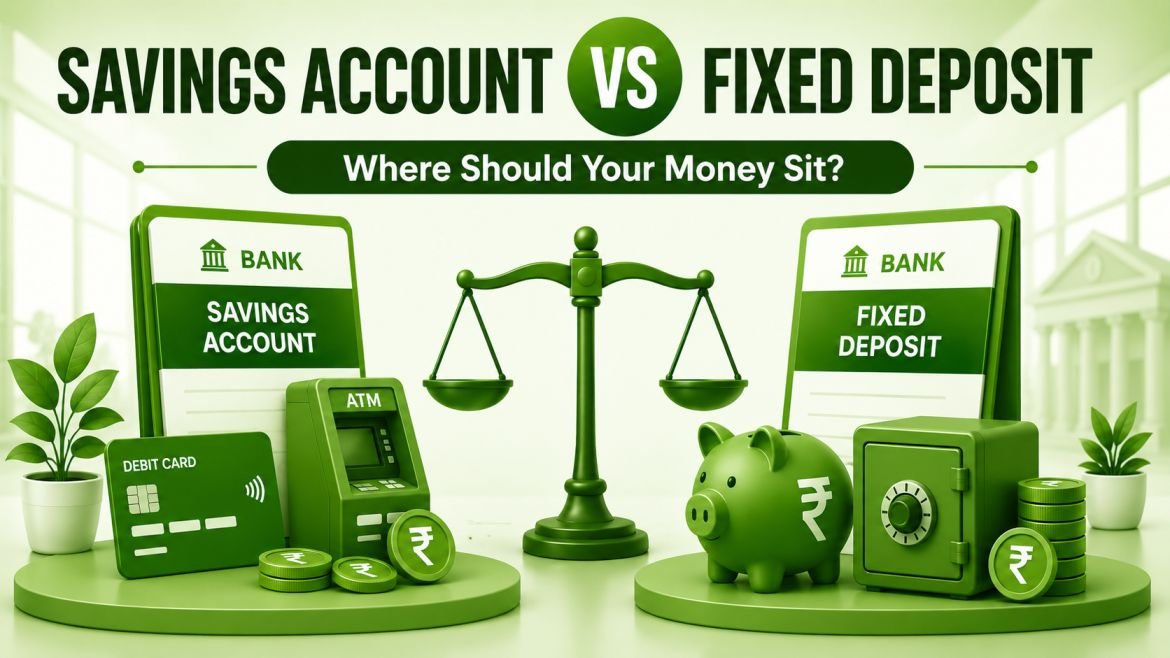
A savings account is built for access. You can withdraw money at an ATM, transfer it instantly, or swipe a debit card against it at any time, and the bank pays you a modest interest rate for keeping your balance there.
A fixed deposit is built for growth. You lock in a sum for a period you choose upfront — say six months or three years — and the bank pays you a higher, fixed rate in exchange for not touching that money until it matures.
The trade-off in one line: a savings account gives you liquidity and a lower return; an FD gives you a better return and asks you to give up quick access for the term you choose.
If you're still deciding which type of savings account to open in the first place, our guide to savings account types covers zero-balance, salary, and senior citizen options before you get to the FD decision.
Why the rate gap exists
Banks pay you more for an FD because they know exactly how long they get to use that money — for lending, for investments, for meeting their own obligations. A savings balance can be withdrawn at any moment, so the bank has to keep more of it liquid and idle, and that flexibility is priced into a lower rate for you.
- Savings account: interest usually sits in a low single-digit range, calculated daily and paid quarterly
- Fixed deposit: interest is usually a few percentage points higher, and often rises the longer you lock the money in
- Longer FD tenures don't always mean higher rates — some banks pay the best rate on medium tenures, not the longest ones
Many banks offer a slightly better FD rate to senior citizens — often about half a percentage point more than the regular rate — on the exact same tenure. It's worth checking this if you're opening an FD for a parent.
Try the FD Calculator
Calculate your FD maturity value and see how much a fixed tenure actually earns.
How the numbers actually play out
Same money, two accounts
In a savings account: earning a typical low single-digit rate, it grows by a modest amount — often not even enough to fully offset inflation
In a one-year FD: at a typical mid-single-digit to high-single-digit rate, the same ₹5 lakh earns a noticeably larger amount over the same 12 months
✅ The FD wins on pure returns for money you don't need to touch — the gap between the two rates compounds meaningfully once the amount or the tenure grows.
What you give up
The catch is access. If an emergency hits and your money is in an FD, you can still get it out — most banks allow premature withdrawal — but you'll usually earn a lower rate than what you signed up for, calculated as a penalty on the interest, not the principal. If you need that money moved quickly once withdrawn, see our NEFT vs RTGS vs IMPS guide to pick the fastest transfer method.
| Feature | Savings account | Fixed deposit |
|---|---|---|
| Access to funds | Instant, anytime | Locked until maturity (early exit possible with penalty) |
| Typical interest | Lower, variable | Higher, fixed for the term |
| Best for | Emergency fund, daily spending | Money earmarked for a future goal |
| Interest paid | Quarterly | Monthly, quarterly, or at maturity — your choice |
| Risk | Very low | Very low (insured up to the deposit insurance limit per bank) |
It's not just about the interest rate
The right account depends on what the money is actually for, not just which one pays more.
When a savings account is the right call
- It's your emergency fund — money you might need on short notice
- You're not sure yet when you'll need it
- You need it for regular bills, rent, or monthly expenses
- The amount is small enough that the rate difference barely matters in rupee terms
When an FD makes more sense
- You have a lump sum with a known future use — a wedding, a down payment, a tax payment due next year
- You want a guaranteed, predictable return with zero market risk
- You're building an FD ladder — splitting money across FDs with different maturity dates so something matures every few months
- You want to keep a portion of your emergency fund earning more, while still being able to break one FD without touching the rest
Common mistake: keeping a large, growing balance in a savings account "just in case" for years on end. Beyond a comfortable emergency cushion — commonly 3 to 6 months of expenses — idle savings-account money is usually money that should be working harder in an FD, a recurring deposit, or another low-risk instrument.
A quick decision checklist
If you're still unsure where a specific sum should sit, run it through these questions in order:
- Could you need this money within 30 days? If yes, stop here — it belongs in a savings account.
- Is this part of your emergency fund (3–6 months of expenses)? If yes, keep it liquid in savings, even if a portion could technically be split into a short FD you can break easily.
- Do you have a specific date this money is needed by? If yes, an FD with a matching tenure usually beats a savings account, since you already know you won't need early access.
- Is the amount large enough that the rate gap is worth the paperwork? On very small sums, the actual rupee difference between the two may not justify the effort of separately tracking an FD.
A simple way to get both
You don't have to pick one account type and stick with it forever.
FD laddering means splitting a lump sum into several smaller FDs with staggered maturity dates instead of one large FD. For example, dividing an amount across FDs that mature every three months gives you a chunk of cash becoming available regularly, while the rest keeps earning the higher FD rate.
Why this works: you get most of the FD rate advantage while reducing the "all my money is locked at once" risk. If you need cash, you either wait for the next FD to mature or break just one small FD instead of your entire savings.
A few more real-life scenarios
Rohit runs a small trading business and keeps ₹10 lakh in his current/savings account as a buffer for supplier payments. After reviewing three months of cash flow, he realises he never actually dips below ₹4 lakh. He moves ₹6 lakh into a short-tenure FD, keeping the rest liquid for day-to-day operations.
Priya, a freelance consultant, gets paid in large, irregular chunks. She keeps 4 months of average expenses in her savings account and routes any surplus from a good month into a short FD, so idle cash between projects still earns a better rate instead of sitting untouched.
Myths vs facts
| Myth | Fact |
|---|---|
| Breaking an FD early means losing part of your principal | Premature withdrawal typically only reduces the interest rate applied, not the original deposit amount |
| A savings account and an FD can't both hold your emergency fund | Many people keep a base cushion in savings and a slightly larger reserve in a short, easily-breakable FD for the same purpose |
| FD rates are the same at every bank | Rates vary meaningfully across banks and tenures, so comparing before locking in is worth the few minutes it takes |
Before opening either account, make sure your KYC is in order — our KYC guide covers exactly what's needed. And if you're managing an FD alongside credit — an EMI, a personal loan, or a credit card — keeping an eye on your CIBIL score is worth doing at the same time.
Frequently asked questions
Is my money safe in a savings account or FD?
Both are considered very low-risk. Bank deposits, including savings accounts and FDs, are covered by deposit insurance up to a set limit per depositor per bank, so spreading large sums across more than one bank can be worth considering if your balance is high.
Can I withdraw my FD before it matures?
Yes, most banks allow premature withdrawal. You'll typically earn a lower interest rate than the one you originally locked in, applied as a small penalty on the interest — your original deposit amount itself isn't reduced.
Is interest from a savings account or FD taxable?
Yes, interest from both is added to your income and taxed at your applicable slab rate. Savings account interest up to a certain limit may qualify for a deduction under some tax provisions, and banks deduct TDS on FD interest once it crosses a threshold in a financial year (FY 2026-27) — you can claim it back at tax filing time if your total tax liability is lower.
Do longer FD tenures always pay higher interest?
Not always. Banks periodically adjust their rate cards, and sometimes a medium-term FD pays the best rate on offer rather than the longest one available. It's worth comparing the rate across a few tenures before locking in, rather than assuming longer always means better.
What is FD laddering and is it worth doing?
It's splitting one large FD into several smaller ones with different maturity dates, so you regularly have an FD maturing instead of all your money locked at once. It's worth considering if you want the better FD rate but don't want to risk needing all your money while it's tied up.
Should I move my entire savings account balance into an FD?
No. Keep an emergency cushion — commonly 3 to 6 months of expenses — easily accessible in your savings account, and consider moving the surplus beyond that into FDs or other instruments where it can earn more.
Can I open an FD with money from my savings account instantly?
Most banks let you open an FD instantly through net banking or a mobile app, transferring funds directly from your linked savings account, without visiting a branch.
What happens to my FD if the bank changes its interest rates later?
Once your FD is booked, the rate is locked in for that tenure regardless of how the bank's rates move afterward — rate changes only apply to new deposits, not ones already running.
Is there a minimum amount needed to open an FD?
Yes, most banks set a minimum FD amount, though it's typically quite low (often a few thousand rupees) and varies by bank — check your specific bank's terms before opening one.