




Key takeaways
- An RD lets you save a fixed amount every month; an FD needs a lump sum upfront
- Both typically offer similar interest rates at a given bank, since both are fixed-tenure deposits
- RDs suit people building savings discipline from regular income; FDs suit people who already have a lump sum
- Both allow premature withdrawal, usually with a penalty on the interest rate
- You can hold both at the same time — they solve different savings problems, not competing ones
Quick answer
You have a lump sum sitting idle: a fixed deposit puts it to work immediately.
You want to build savings from your monthly salary or income: a recurring deposit builds the discipline of saving a fixed amount every month.
The core difference
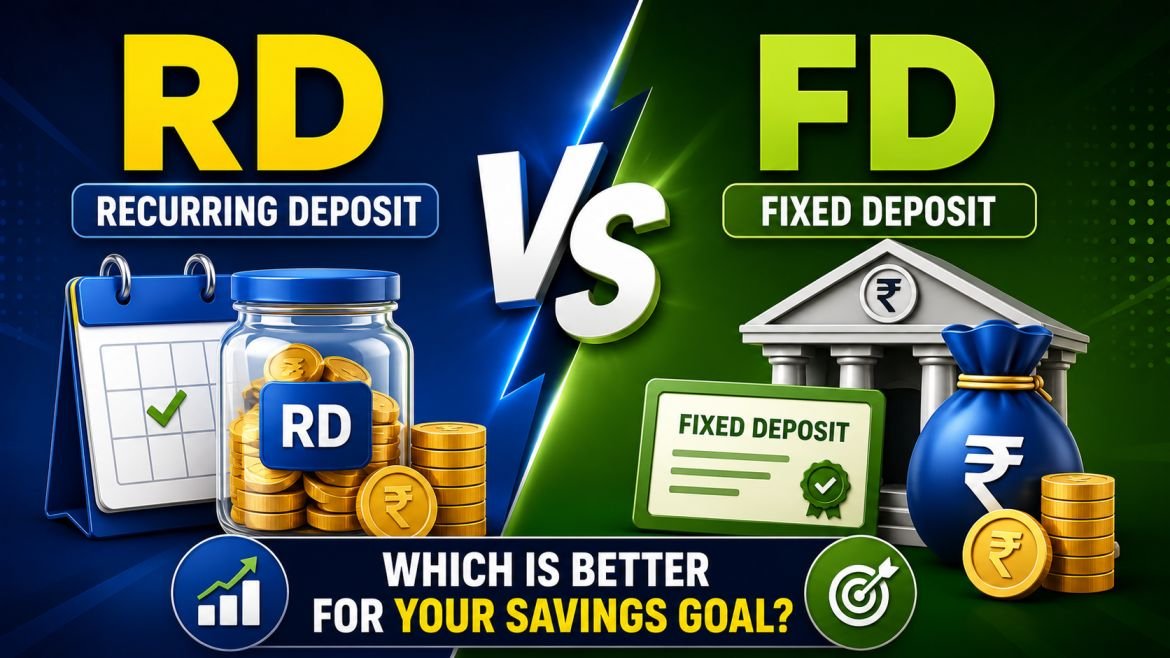
A fixed deposit (FD) is a one-time lump sum locked in for a chosen tenure at a fixed interest rate. A recurring deposit (RD) is the opposite in structure — you commit to depositing a fixed amount every month for a chosen tenure, and the bank pays interest on the accumulated balance.
Same rate, different starting point. Most banks apply similar interest rates to RDs and FDs of the same tenure. The real difference isn't the rate — it's whether you have a lump sum ready now or want to build one gradually.
How each grows
- FD: the entire principal starts earning interest from day one
- RD: each month's instalment earns interest only from the date it's deposited, so the total maturity value builds up gradually rather than compounding on a lump sum from the start
Try the RD Calculator
Use the RD calculator to see what your monthly savings could grow into by maturity.
Side-by-side comparison
| Feature | Recurring deposit (RD) | Fixed deposit (FD) |
|---|---|---|
| Investment style | Fixed monthly instalments | One-time lump sum |
| Best for | Building savings from regular income | Growing an existing lump sum |
| Interest rate | Typically similar to FD for the same tenure | Typically similar to RD for the same tenure |
| Minimum tenure | Usually 6 months, varies by bank | Usually 7 days, varies by bank |
| Premature withdrawal | Allowed, usually with a penalty on interest | Allowed, usually with a penalty on interest |
| Missed instalment | May attract a small penalty per missed month | Not applicable — no recurring commitment |
How this plays out in real life
Ananya earns ₹60,000/month and struggles to save consistently. She starts a ₹5,000/month RD for 2 years, treating it like a fixed expense that leaves her account right after salary day — building both savings and discipline.
Rohit's business had a good quarter and he has ₹6 lakh sitting idle in his current account. Since it's a lump sum with no immediate use, he puts it into a 1-year FD rather than an RD, since he already has the full amount ready.
Priya, a student, gets ₹3,000/month as pocket money and wants to save toward a laptop next year. A recurring deposit fits her situation better than an FD, since she doesn't have a lump sum to begin with.
Karan's freelance income varies month to month. In a good month, he puts a lump sum into a short-term FD; in leaner months, he skips it. He finds an FD easier to manage than an RD, which expects a fixed monthly commitment regardless of income.
Mr. and Mrs. Sharma have their retirement corpus in FDs already. They also start a small RD using a portion of their monthly pension, simply to keep building a separate maturity amount for their grandchild's future expenses. If that grandchild is a granddaughter under 10, a Sukanya Samriddhi Yojana account is worth comparing too, since it's purpose-built for exactly this kind of goal.
Pros and cons
✅ RD: builds savings discipline, works well without a lump sum, ideal for salaried individuals
✅ FD: full amount earns interest from day one, more flexible tenure options, no monthly commitment risk
A quick decision checklist
If you're still unsure whether a specific goal calls for an RD or an FD, run through these questions in order:
- Do you already have the full amount in hand today? If yes, an FD puts it to work immediately rather than trickling it in over months.
- Are you starting from zero and building up from a monthly income? If yes, an RD gives you a structured, hard-to-skip way to save toward the same goal.
- Is your income irregular month to month? If yes, an FD (opened whenever you have a surplus) may suit you better than an RD's fixed monthly commitment.
- Do you want to keep both options running for different goals? Most people eventually do — an FD for lump sums as they arrive, and an RD for disciplined monthly building toward a separate goal.
What if your income varies month to month?
An RD's biggest strength — the fixed monthly commitment — can also be its biggest friction point if your income isn't predictable. A few practical ways around this:
- Set the RD instalment amount based on your lowest-earning month, not your average or best month, so it's sustainable even in a lean period
- If you consistently have surplus beyond the RD amount, route it into a separate short-tenure FD instead of increasing the RD instalment, since RD amounts usually can't be changed mid-tenure
- Keep a small buffer in your savings account specifically to cover the RD instalment during an unusually tight month, rather than letting the RD lapse
Common mistakes to avoid
Common mistake: starting an RD with a monthly amount that's too high to sustain. Missing instalments repeatedly can lead to penalties and, in some cases, account closure before maturity.
- Choosing an RD tenure that doesn't match your actual savings goal timeline
- Breaking an FD early without checking the interest penalty first
- Assuming RD returns will match a lump-sum FD of the same total amount — they won't, since RD instalments earn interest for less time on average
- Not comparing rates across banks before locking in either instrument
Myths vs facts
| Myth | Fact |
|---|---|
| RD always gives a lower return than FD | The rate is often similar; the RD's lower total maturity value (for the same total sum) comes from instalments earning interest for a shorter average time, not a lower rate |
| You can only have one or the other | Most people benefit from both — an FD for lump sums and an RD for ongoing monthly savings |
| Missing one RD instalment closes the account immediately | Most banks charge a small penalty for missed instalments rather than closing the account outright, though repeated misses can lead to closure |
Best practices
- Set your RD instalment at an amount you can commit to comfortably every month, not the maximum you can afford
- Use an FD for lump sums you receive from bonuses, maturity payouts, or business income
- Consider laddering both RDs and FDs so you have staggered maturity dates across your savings
- Automate RD instalments through standing instructions so you never miss a due date
- If you're weighing a tax-saving alternative to a plain FD, our NSC vs FD guide and Section 80C guide cover the tax-linked options worth comparing
Frequently asked questions
Which gives a higher return, RD or FD?
For the same total amount invested, an FD usually yields a higher maturity value than an RD, because the full lump sum earns interest from day one, while RD instalments each earn interest only from their deposit date.
Can I withdraw my RD before maturity?
Yes, most banks allow premature withdrawal of an RD, usually with a lower interest rate applied as a penalty, similar to FD premature withdrawal rules.
What happens if I miss an RD instalment?
Banks typically charge a small penalty for each missed instalment. Missing several instalments in a row can, in some cases, lead to the account being closed before maturity.
Is RD or FD better for a salaried person?
An RD often suits salaried individuals well since it builds a savings habit tied to a regular monthly income, though an FD is equally useful if a lump sum becomes available, such as a bonus.
Is interest from RD and FD taxed the same way?
Yes, interest earned from both RDs and FDs is added to your taxable income and taxed at your applicable slab rate, with TDS deducted by the bank once interest crosses the prescribed threshold in a financial year (FY 2026-27).
Can I open an RD and FD in the same bank at the same time?
Yes, there's no restriction on holding both simultaneously, either in the same bank or across different banks.
What is the minimum tenure for an RD?
This varies by bank, but many banks set the minimum RD tenure at around 6 months, with maximum tenures extending to several years.
Do senior citizens get a higher rate on RDs too?
Many banks extend the same senior citizen rate benefit to RDs as they do to FDs, though it's worth confirming with your specific bank. Our Senior Citizen Savings Scheme guide covers a dedicated government-backed option worth comparing too.
Can I increase my RD instalment amount later?
Generally no — the instalment amount is fixed when you open the RD. If you want to save more, you'd typically need to open a separate RD or FD rather than modify the existing one.
Which is easier to manage, RD or FD?
An FD requires a single decision upfront with no ongoing commitment, while an RD requires monthly discipline. Which is "easier" depends on whether you already have the lump sum or are building toward one.
Can I close my RD or FD online?
Most banks allow you to close both an RD and an FD through net banking or a mobile app, with the balance (minus any applicable penalty for early closure) credited directly to your linked savings account.
What happens to an RD if the account holder passes away before maturity?
The nominee or legal heir can typically claim the accumulated balance, including interest earned up to that point, by submitting the required documents to the bank — similar to the process for an FD.
Is there a maximum monthly amount for an RD?
Most banks don't set a strict upper cap on the monthly RD instalment, though very large recurring amounts may prompt additional documentation or KYC checks depending on the bank's policy.
If I'm saving toward retirement instead of a short-term goal, is RD or FD still the right tool?
For genuinely long-term, retirement-horizon goals, tax-free options like PPF often outperform RD or FD once tax is factored in. Our PPF vs EPF guide and PPF withdrawal rules guide cover that longer-horizon comparison in depth.