




Key takeaways
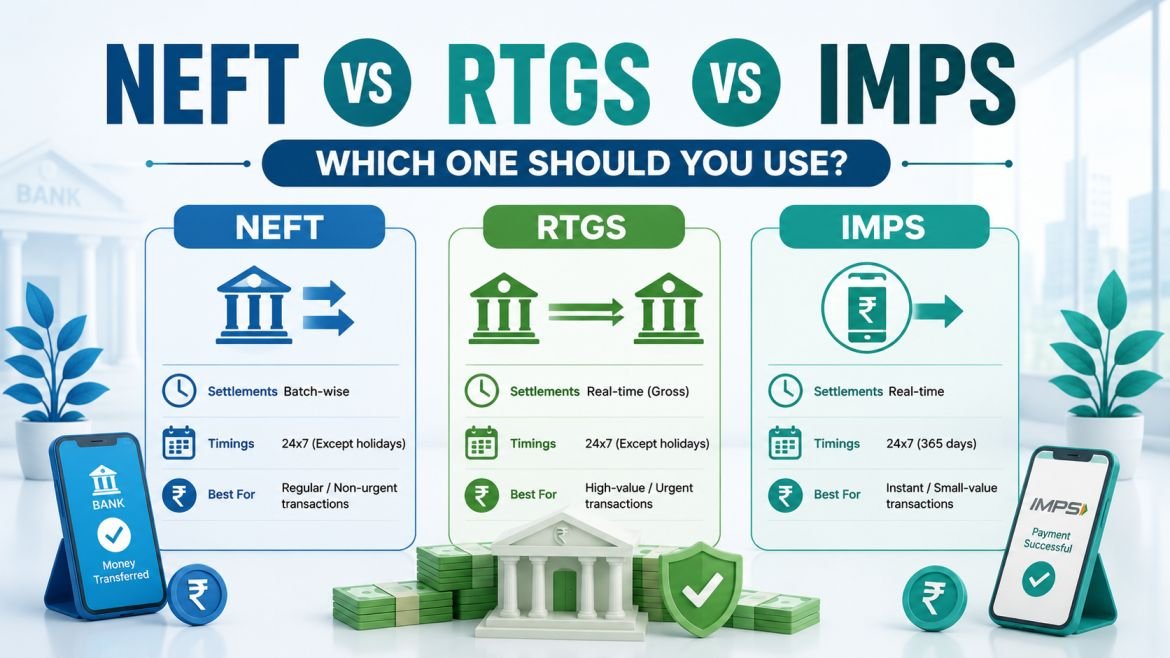
- NEFT, RTGS and IMPS are the three main bank-to-bank transfer methods in India, alongside UPI
- RTGS is for large amounts (₹2 lakh and above) and settles individually in near real-time
- NEFT works for any amount and settles in batches, usually within minutes, but isn't instant
- IMPS is instant, works 24x7 including holidays, but usually has a lower per-transaction limit than RTGS
- All three are now available 24x7, 365 days a year at most banks, and RBI has waived charges on transfers done online through NEFT and RTGS
Quick answer
Sending a small, everyday amount instantly: use IMPS or UPI.
Sending any amount and you can wait a few minutes: use NEFT.
Sending a large amount (₹2 lakh+) and need it credited almost immediately: use RTGS.
What are NEFT, RTGS and IMPS?
All three are electronic methods to move money from one bank account to another in India, regulated by the Reserve Bank of India (RBI). The difference lies in how fast they settle, how much you can send, and when they're available. If you're setting up a new account before making transfers like these, our guide to savings account types and KYC explainer cover the account-opening basics.
NEFT (National Electronic Funds Transfer)
NEFT moves money in batches. Your transfer joins a queue and gets settled in half-hourly batches round the clock. There's no minimum or maximum limit set by RBI, though individual banks may cap the amount for retail customers through internet banking.
RTGS (Real Time Gross Settlement)
RTGS is built for high-value transfers. Each transaction is settled individually and immediately, one at a time, rather than in a batch. The minimum amount for RTGS is ₹2 lakh — there's no upper limit.
IMPS (Immediate Payment Service)
IMPS, run by NPCI, is designed purely for speed. Money reaches the recipient's account within seconds, any time of day, any day of the year. Most banks cap IMPS at a lower per-transaction limit than RTGS, though this varies by bank and channel.
Don't confuse these with UPI. UPI is a separate payment system that often uses IMPS rails underneath, but it's linked to a VPA (like name@bank) instead of an account number and IFSC. For person-to-person small payments, UPI has largely replaced IMPS for everyday use.
Try the FD Calculator
Moving a lump sum to a fixed deposit? Calculate your maturity value first.
Side-by-side comparison
| Feature | NEFT | RTGS | IMPS |
|---|---|---|---|
| Settlement | Batch-wise, every 30 minutes | Real-time, one at a time | Real-time, instant |
| Minimum amount | No minimum | ₹2 lakh | No minimum |
| Maximum amount | No RBI cap (bank-specific limits may apply) | No upper limit | Bank-specific cap, generally lower than RTGS |
| Availability | 24x7, all days | 24x7, all days | 24x7, all days including holidays |
| Speed | Minutes (within the batch cycle) | Near-instant | Seconds |
| Best for | Regular payments, salary, vendor payments | Property purchases, large business payments | Urgent, smaller everyday transfers |
How this plays out in real life
Ananya needs to pay her landlord ₹25,000 on the 1st of every month. Since it's a modest amount and she isn't in a rush, she sets up NEFT so it goes through automatically without worrying about instant crediting.
Rohit runs a small trading business and needs to pay a supplier ₹3.5 lakh today so his goods aren't held up. Because the amount crosses ₹2 lakh and he needs it credited quickly, he uses RTGS.
Priya, a college student, owes her flatmate ₹1,200 for groceries. She sends it instantly using IMPS through her bank's mobile app — no waiting, no batch cycle.
Karan, a freelance designer, is waiting on a ₹40,000 payment from a client on a Sunday. Since NEFT and RTGS both work on all days now, and IMPS is instant regardless of the day, the client can choose any of the three and Karan still gets paid without delay.
Mr. and Mrs. Sharma want to move ₹5 lakh from their savings account into a fixed deposit at another bank for a better rate. Since it's a large amount and they want it settled the same day, RTGS is the natural choice.
Are there charges?
RBI has directed banks not to charge customers for NEFT and RTGS transactions initiated online (through internet banking or mobile apps). Charges may still apply if you walk into a branch and do it through a bank representative, and IMPS charges vary by bank and the amount transferred. It's worth checking your bank's latest charges before a large or frequent transfer.
✅ Doing transfers through your bank's app or net banking, rather than at a branch counter, is usually the cheapest and fastest route for all three methods.
Common mistakes to avoid
Common mistake: attempting an RTGS transfer for an amount below ₹2 lakh. It simply won't go through — use NEFT or IMPS instead for smaller amounts.
- Entering the wrong IFSC code — this can send money to the wrong branch or delay the transfer
- Assuming NEFT is instant — it settles in batches, so there can be a short wait even though it's usually quick
- Not checking your bank's specific IMPS or NEFT transfer limit before attempting a large transaction
- Forgetting that RTGS requires the minimum ₹2 lakh threshold to be met
Myths vs facts
| Myth | Fact |
|---|---|
| NEFT only works on weekdays and banking hours | NEFT now operates 24x7, including weekends and holidays |
| RTGS is only for businesses | Any individual can use RTGS as long as the amount is ₹2 lakh or more |
| IMPS and UPI are the same thing | UPI is a separate system that often runs on IMPS rails but uses a different identifier (VPA) and app experience |
| All three methods always come free | Branch-assisted transfers may still attract charges; only online NEFT/RTGS is universally free per RBI's directive |
Best practices
- Always double-check the account number and IFSC code before confirming any transfer
- Use IMPS or UPI for small, urgent amounts; NEFT for routine payments; RTGS for high-value, time-sensitive transfers
- Save frequently used beneficiaries in your net banking or app to avoid manual entry errors
- Keep the transaction reference number until the transfer is confirmed at the recipient's end
What to do if a transfer fails or is delayed
Occasionally a transfer doesn't show up instantly even through IMPS, or an NEFT batch seems to be taking longer than expected. Before assuming the money is lost, work through this checklist:
- Check your bank statement or passbook first — sometimes the debit has happened but the confirmation message is delayed
- Note down the UTR (Unique Transaction Reference) number from your transfer confirmation — you'll need this for any complaint
- If the amount was debited from your account but not credited to the recipient, most banks auto-reverse it within a couple of working days; if it doesn't, raise a complaint with your bank quoting the UTR
- Double-check the recipient's account number and IFSC — a mismatch is the most common reason a transfer doesn't reach the intended account
Keep the UTR number until you've confirmed the credit. It's the single reference your bank and the recipient's bank use to trace a transfer, and having it ready speeds up resolution considerably if something needs to be escalated.
Anil, an NRI, needs to transfer ₹2.5 lakh to his parents' account in India for a medical expense. Since the amount is close to the RTGS threshold and he wants it credited the same day, he opts for RTGS rather than waiting on an NEFT batch cycle, and keeps the UTR handy in case his parents don't see the credit within the hour.
Frequently asked questions
What is the minimum amount for RTGS?
RTGS requires a minimum transfer amount of ₹2 lakh. There is no maximum limit set by RBI, though your bank may have its own ceiling for retail internet banking.
Is NEFT instant?
Not quite. NEFT settles in half-hourly batches round the clock, so there can be a short delay of a few minutes rather than an instant credit like IMPS.
Which is faster, IMPS or RTGS?
IMPS is generally faster for smaller amounts since it's designed for instant, seconds-level transfers. RTGS is also near-instant but is meant for high-value transfers of ₹2 lakh and above.
Do banks charge for NEFT and RTGS?
RBI has waived charges for NEFT and RTGS transactions initiated online through internet banking or mobile banking. Branch-assisted transactions may still involve a fee, so check with your bank.
Can I use NEFT, RTGS or IMPS on a Sunday or public holiday?
Yes. All three services are now available 24x7, including weekends and public holidays, at most banks in India.
What is the maximum amount I can send through IMPS?
This depends on your bank and the channel you use (mobile app, net banking, or branch). It's usually lower than the RTGS threshold, so check your bank's current limit before a large IMPS transfer.
Is UPI better than IMPS?
For everyday, smaller payments between individuals, UPI is generally more convenient since it doesn't require account number and IFSC details. IMPS remains useful for transfers where UPI isn't set up or higher limits are needed.
Which transfer method should I use to buy a property?
Property transactions usually involve large sums, so RTGS is the common choice, since it settles high-value amounts individually and near-instantly.
Can NEFT be used for amounts below ₹2 lakh?
Yes. Unlike RTGS, NEFT has no minimum amount requirement, so it works for both small and large transfers.
What happens if I enter the wrong account number in a transfer?
The transfer may fail or, in rare cases, be credited to the wrong account. Contact your bank immediately if you notice an error, since recovering wrongly transferred funds depends on the receiving bank and account holder's cooperation.
Do I need to add a beneficiary before making a transfer?
Most banks require you to add and sometimes activate a beneficiary (which can take a few hours) before you can transfer funds through net banking or a mobile app, as a security measure.
What is a UTR number and why does it matter?
A UTR (Unique Transaction Reference) number is generated for every NEFT, RTGS or IMPS transfer. It's the reference your bank uses to trace, confirm, or investigate a transaction, so it's worth noting down until the recipient confirms the credit.
Can I cancel a transfer once it's been initiated?
Generally no, once an NEFT, RTGS or IMPS transfer is processed it cannot be cancelled or reversed by the sender. If funds were sent to the wrong account, you'll need to contact your bank, which will coordinate with the recipient's bank to attempt a reversal.
Is there a limit on how many transfers I can make in a day?
Banks may set a daily cumulative limit across NEFT, RTGS and IMPS for retail internet banking or mobile app users, separate from the per-transaction limit. This varies by bank, so check your specific bank's transaction limits if you're making several large transfers in one day.