




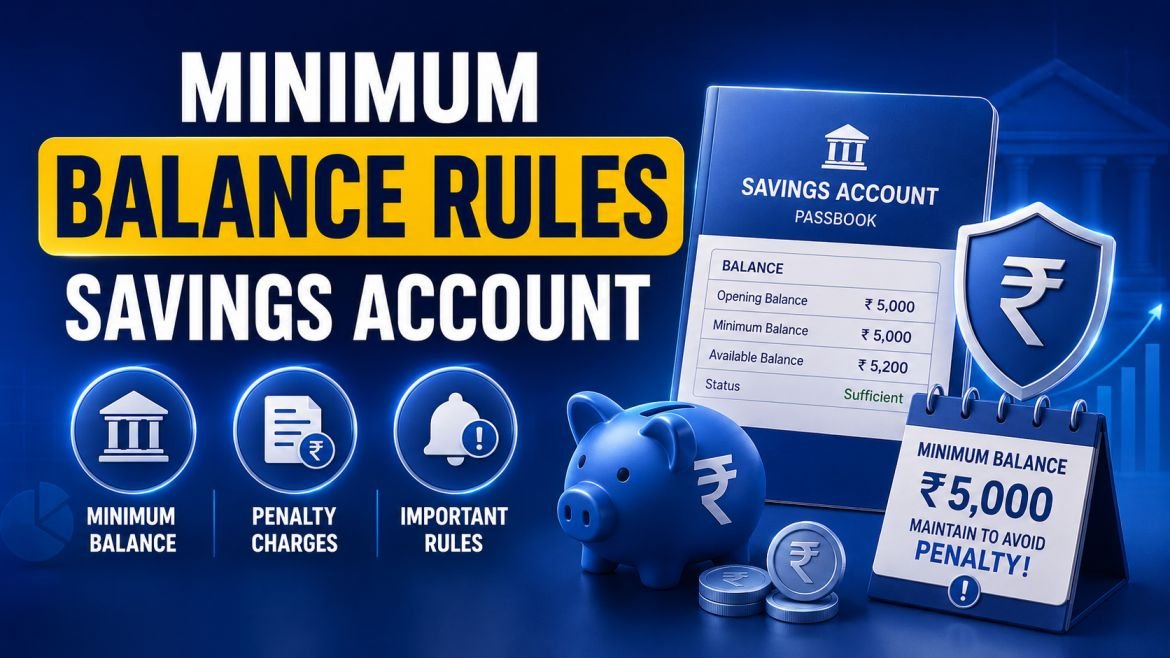
Key takeaways
- Most savings accounts require an Average Monthly Balance (AMB), not a balance on any single day — it's calculated across the whole month
- Falling short triggers a penalty, typically ₹100-600 per instance depending on the bank and how large the shortfall is
- Metro and urban accounts usually have higher minimum balance requirements than rural or semi-urban accounts at the same bank
- Zero-balance (Basic Savings Bank Deposit) accounts exist specifically to avoid this requirement, with some trade-offs on features
- Penalties are capped by RBI guidelines — banks can't charge more than a specified percentage of the shortfall
Quick answer
If your account balance falls below the required minimum, the bank deducts a penalty — typically ₹100 to ₹600 depending on your bank, branch location (metro/urban/rural), and how large the shortfall is relative to the requirement. Most banks calculate this using your Average Monthly Balance (AMB) across the full month, not your balance on any single day, and give some leeway before penalising.
How Average Monthly Balance is actually calculated
A common misconception is that banks check your balance on the last day of the month. In reality, most use AMB — the average of your closing balance across every day in the month.
If your required minimum is ₹10,000 and your daily closing balances for a 30-day month add up to ₹2,40,000 in total, your AMB is ₹2,40,000 ÷ 30 = ₹8,000 — below the requirement, even if your balance touched ₹15,000 on some days.
Practically, this means a large one-time deposit near month-end won't necessarily save you from a penalty if your balance was low for most of the month — someone who lets their balance run low after paying rent early, then tops up just before the statement date, can still get charged even though their end-of-month balance looks healthy. Keeping a steady buffer throughout the month matters more than a single top-up.
Typical minimum balance requirements
| Branch location | Typical AMB requirement (private banks) | Typical AMB requirement (public sector banks) |
|---|---|---|
| Metro/Urban | ₹10,000 - ₹25,000 | ₹3,000 - ₹10,000 |
| Semi-urban | ₹5,000 - ₹15,000 | ₹2,000 - ₹5,000 |
| Rural | ₹2,500 - ₹10,000 | ₹1,000 - ₹3,000 |
These figures vary significantly by bank and even by specific account type. Premium or salary accounts sometimes waive the requirement entirely, while basic savings accounts at the same bank can have strict AMB rules. Always check your specific account's terms rather than assuming a general figure applies.
How the penalty is calculated
Banks typically charge a penalty proportional to the shortfall — the bigger the gap between your AMB and the requirement, the higher the fee, up to a capped maximum.
A bank requiring ₹10,000 AMB might charge: ₹100 for a shortfall up to 50% of the requirement, ₹300 for a 50-75% shortfall, and ₹600 for a shortfall greater than 75% — plus applicable GST on the charge. Exact slabs differ by bank.
RBI guidance: banks are expected to notify customers before levying a penalty and cannot charge a fee that brings the account balance into negative territory purely due to the penalty itself. If you feel you've been overcharged, you can raise this with the bank's grievance cell.
How to avoid the penalty entirely
- Set up a standing instruction: auto-transfer a fixed amount into your savings account each month to stay above the threshold.
- Switch to a zero-balance account: Basic Savings Bank Deposit (BSBD) accounts, offered by all banks, have no minimum balance requirement, though they may cap free transactions or ATM withdrawals per month.
- Link to a salary account: most salary accounts waive minimum balance requirements as long as the salary credit continues.
- Consolidate idle accounts: if you have multiple low-use savings accounts, each with its own minimum balance requirement, consider closing the ones you don't actively need.
Try the FD Calculator
If you're holding idle balance well above your minimum requirement, consider moving the surplus into an FD for better returns.
Frequently asked questions
Is minimum balance checked daily or monthly?
Most banks use Average Monthly Balance (AMB) — the average of your daily closing balances across the entire month — rather than checking on a single specific day.
Can I get a zero-balance account instead?
Yes, every bank in India is required to offer a Basic Savings Bank Deposit (BSBD) account with no minimum balance requirement, though it may have limits on free monthly transactions or additional features compared to a regular savings account.
Does the minimum balance requirement differ by branch?
Yes — most banks set different AMB requirements for metro, urban, semi-urban, and rural branches, with metro branches typically requiring the highest balance.
Is there a cap on how much a bank can charge as penalty?
RBI guidelines require the penalty to be reasonable and proportionate to the shortfall, and prohibit charges that would push the account into a negative balance purely due to the penalty itself. Exact caps vary by bank policy within these guidelines.
Does the bank warn me before charging a minimum balance penalty?
Most banks are expected to notify customers, typically via SMS or email, when the balance is trending below the required minimum, giving some room to top up before the charge is applied. Practices vary by bank, so it's worth checking your specific bank's notification policy rather than assuming you'll always get a warning.
Can I convert my existing account to a zero-balance account if I keep getting charged?
In most cases yes — you can visit your branch or use net banking to request conversion to a Basic Savings Bank Deposit account, though this may mean giving up certain features like a chequebook or reducing free transaction limits, depending on the bank's terms.
Does a salary account have a minimum balance requirement?
Most salary accounts waive the minimum balance requirement as long as a regular salary credit continues into the account. If the salary credit stops for a few consecutive months, some banks automatically convert it to a regular savings account, which then carries the usual AMB requirement.
Which account types are exempt from minimum balance rules
Not every savings account carries the same requirement — the account type itself often determines whether you need to worry about this at all.
| Account type | Minimum balance requirement | Who it's for |
|---|---|---|
| Basic Savings Bank Deposit (BSBD) | None | Anyone wanting a no-frills account; limited free transactions/month |
| Regular savings account | AMB applies (varies by branch location) | General banking needs with full features |
| Salary account | Usually waived while salary credits continue | Salaried employees, opened via employer tie-up |
| Senior citizen savings account | Often lower AMB or waived, depending on bank | Individuals aged 60+ |
| Student/minor account | Usually zero or very low | Students, minors with guardian |
| Pradhan Mantri Jan Dhan Yojana (PMJDY) account | None | Financial inclusion scheme, no minimum balance mandated |
If minimum balance penalties are a recurring problem for you, it's often simpler to switch account types than to keep topping up a regular account. A BSBD or PMJDY account removes the requirement entirely, at the cost of some features like chequebooks or higher transaction limits.
Common mistakes people make with minimum balance
- Assuming a single healthy balance check is enough: as shown in Deepak's example above, banks look at the average across the month, not a snapshot on any one day.
- Not accounting for auto-debits: SIP auto-debits, insurance premiums, or loan EMIs scheduled from the same account can silently pull the balance below the threshold if not tracked carefully.
- Ignoring dormant secondary accounts: old accounts opened for a specific purpose (like a company that's since changed payroll banks) often get forgotten, quietly accumulating minimum balance charges over months.
- Not checking the requirement after moving cities: AMB requirements often differ between metro, urban, and rural branches — if your home branch was reclassified or you moved your account, the requirement may have changed without you noticing.
- Overlooking that penalties compound the problem: a penalty deducted for a shortfall can itself push the balance further below the requirement the following month, leading to repeat charges if not corrected promptly.