




Key takeaways
- EMI stands for Equated Monthly Instalment — the fixed amount you pay your bank every month
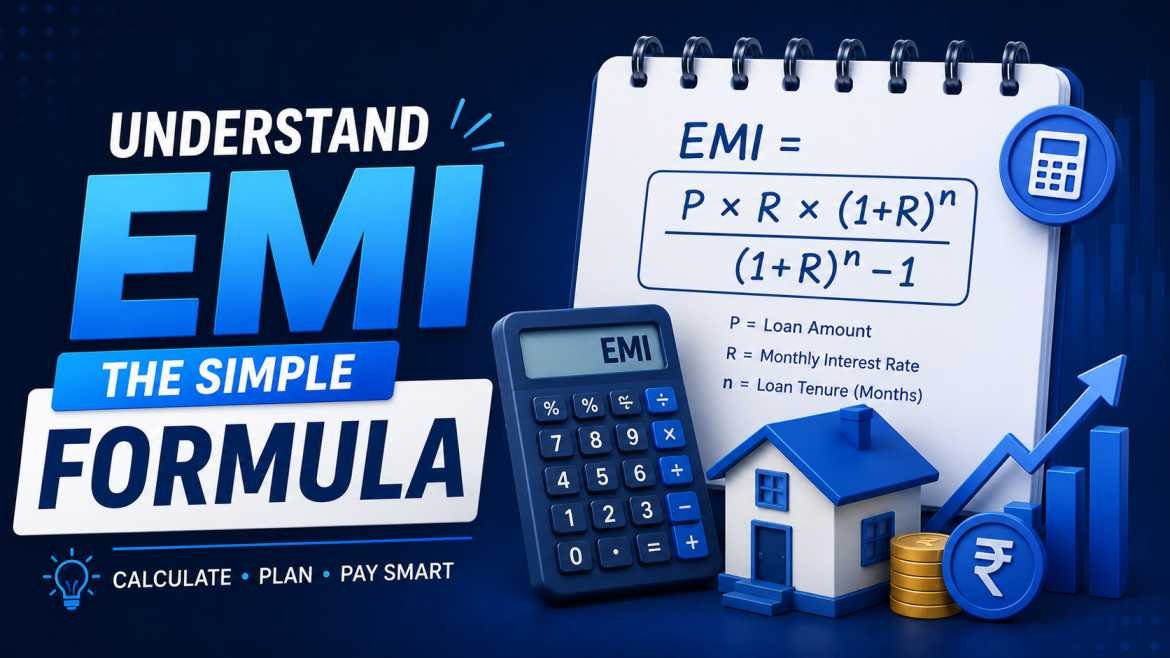
- The formula is EMI = P x R x (1+R)^N / [(1+R)^N - 1], but you never need to calculate it by hand
- P is how much you borrowed, R is your monthly interest rate, N is your loan tenure in months
- In the early years, most of your EMI goes toward interest. In the later years, most of it goes toward paying off the actual loan
- Home loan rates vary based on your credit score, lender, and prevailing market conditions — always check current rates before comparing offers
Quick answer
EMI is simply your fixed monthly loan payment. Banks calculate it using a formula that considers how much you borrowed, your interest rate, and how many months you'll take to repay it. You don't need to do this maths yourself — but understanding it helps you make smarter loan decisions.
What EMI actually means
EMI stands for Equated Monthly Instalment. For the fuller picture of how EMI works day to day — including what happens if you miss a payment — see our complete guide to what EMI means.
"Equated" just means the amount stays the same every month. Whether it's your first payment or your last, you pay the exact same number.
Behind the scenes, though, that fixed payment is made up of two changing parts: interest and principal.
Imagine you borrow money from a friend and agree to pay them back Rs.10,000 every month for a year, which includes some extra as a "thank you" for lending it to you. Your friend is charging interest, and your Rs.10,000 is your EMI — a bank works the exact same way, just with a formula to make sure the numbers are fair and consistent.
The EMI formula, explained simply
Here's the formula banks use:
EMI = P x R x (1+R)^N / [(1+R)^N - 1]
That looks confusing, so let's break it into three simple pieces.
| Letter | What it means, in plain words |
|---|---|
| P | The amount you borrowed (Principal) |
| R | Your monthly interest rate |
| N | How many months you'll repay over |
The one tricky part: banks quote interest rates per year, not per month. So before using the formula, you have to convert the yearly rate into a monthly rate — divide it by 12, and then divide by 100 to turn it into a decimal.
Try the EMI Calculator
Skip the maths entirely — enter your loan details and get your exact EMI in seconds.
Example 1: A simple Rs.1 lakh loan
Let's start small, so the maths is easy to follow.
Step 1 - Find P: Rs.1,00,000
Step 2 - Find R: 9% per year / 12 / 100 = 0.0075 per month
Step 3 - Find N: 12 months
Result: your EMI comes out to roughly Rs.8,745 per month
Over 12 months, you'd pay back Rs.1,04,940 in total - meaning you paid about Rs.4,940 in interest for borrowing Rs.1,00,000 for a year.
Example 2: A real-world home loan
Now let's look at a number closer to what most people actually borrow.
Step 1 - Find P: Rs.30,00,000
Step 2 - Find R: 8.5% per year / 12 / 100 = 0.00708 per month
Step 3 - Find N: 240 months
Result: your EMI comes out to roughly Rs.26,035 per month
Over 20 years, that's a total repayment of about Rs.62.5 lakh - meaning you'd pay roughly Rs.32.5 lakh in interest alone, on a Rs.30 lakh loan.
Example 3: Same loan, shorter tenure
Here's the same Rs.30 lakh loan, but repaid faster - over 10 years instead of 20.
Result: your EMI jumps to roughly Rs.37,192 per month
Total interest paid: only about Rs.14.6 lakh, instead of Rs.32.5 lakh
A higher EMI, but you save almost Rs.18 lakh in interest simply by choosing a shorter tenure. This is the trade-off every borrower faces: lower monthly payment vs. lower total cost.
How this actually played out for one borrower
Divya was approved for a Rs.30 lakh home loan at 8.5% and the bank defaulted her paperwork to a 20-year tenure, with an EMI of roughly Rs.26,035. It looked comfortable against her salary, so she nearly signed without a second thought.
Before signing, she ran the same loan through a 10-year tenure out of curiosity — the EMI jumped to about Rs.37,192, roughly Rs.11,000 more a month. That felt tight at first, but her salary had enough room to absorb it. She switched to the 10-year option and ended up saving close to Rs.18 lakh in total interest over the life of the loan, exactly as shown in Example 3 above — a decision that took her five extra minutes with a calculator before signing anything.
Why your interest-vs-principal split changes every month
Here's something that confuses a lot of people: your EMI amount never changes, but what it's actually paying for does.
Almost every loan in India uses something called the reducing balance method. This means your bank only charges interest on the amount you still owe - not on the original loan amount. If you're curious how this compares to the older "flat rate" method some smaller loans still use, see our flat rate vs reducing balance guide.
Month 1: around 70-75% of your EMI is interest, only 25-30% actually reduces your loan
Month 120 (halfway): the split is closer to 45-50% interest, 50-55% principal
Month 240 (final year): almost your entire EMI now goes toward the loan itself, with very little interest left
Why this matters: since early payments are mostly interest, paying extra money toward your loan early on saves you far more than paying the same extra amount later. This is why prepaying a loan in year 2 is much more valuable than prepaying in year 15 — our guide to how prepayment saves money breaks this down with more worked examples.
The three things that control your EMI
Only three numbers go into the formula - so only three things can actually change your EMI.
1. How much you borrow (P)
Borrow more, and your EMI goes up roughly in proportion. Simple.
2. Your interest rate (R)
A higher rate means a higher EMI - and the effect gets bigger the longer your loan tenure is.
3. Your tenure (N)
A shorter tenure means a higher EMI, but as Divya's example and Example 3 above show, it can save you a huge amount in total interest.
Common mistake: choosing the longest possible tenure just to make the EMI look smaller, without checking how much extra you'll pay in total interest over the life of the loan — almost exactly what Divya nearly did before double-checking the numbers.
How home loan rates are set
Most home loans in India today are linked to an external benchmark - usually the RBI's repo rate. This means your lender's interest rate moves up or down whenever the RBI revises the repo rate, and that change typically passes through to your EMI within 1 to 3 months, depending on your bank's reset cycle.
Did you know? Because rates move with RBI policy, the "typical range" for home loan interest changes over time. Rather than relying on a fixed number, check your lender's current published rate — or use a live EMI calculator — before comparing loan offers.
Try the EMI Calculator
Check current rates and see your exact EMI instantly.
For a full walkthrough of every field in the calculator itself — not just the formula behind it — see our step-by-step guide to using the EMI calculator.
Frequently asked questions
What is the EMI formula in simple words?
EMI = P x R x (1+R)^N / [(1+R)^N - 1]. In plain terms: P is how much you borrowed, R is your monthly interest rate, and N is how many months you'll take to repay. Plug in your numbers and the formula gives you your fixed monthly payment.
Do I need to calculate my EMI manually?
No - an EMI calculator does this instantly. Understanding the formula is mainly useful for knowing how prepayments, rate changes, or a shorter tenure will affect your total cost, not for everyday calculation.
Why does my EMI stay the same but the interest amount changes?
Because your loan uses the reducing balance method - interest is recalculated every month based only on what you still owe. As you repay your loan, that outstanding amount shrinks, so the interest portion of your fixed EMI shrinks too, while the principal portion grows.
Does a shorter loan tenure always save money?
Yes, in terms of total interest paid - a shorter tenure almost always means less total interest, even though your monthly EMI is higher, exactly like Divya's example above. The trade-off is affordability: you need to be sure you can comfortably manage the higher monthly payment.
How does the RBI repo rate affect my EMI?
If you have a floating-rate loan linked to the repo rate, changes in the RBI's rate typically pass through to your EMI within 1 to 3 months. When the repo rate rises, floating-rate EMIs usually rise too; when it falls or stays steady, EMIs tend to follow the same pattern.
Is a lower EMI always a better deal?
Not necessarily. A lower EMI often comes from a longer tenure, which usually means paying significantly more total interest over the life of the loan — this is exactly the trap Divya nearly fell into above. Always compare the total repayment amount, not just the monthly figure, before deciding.