




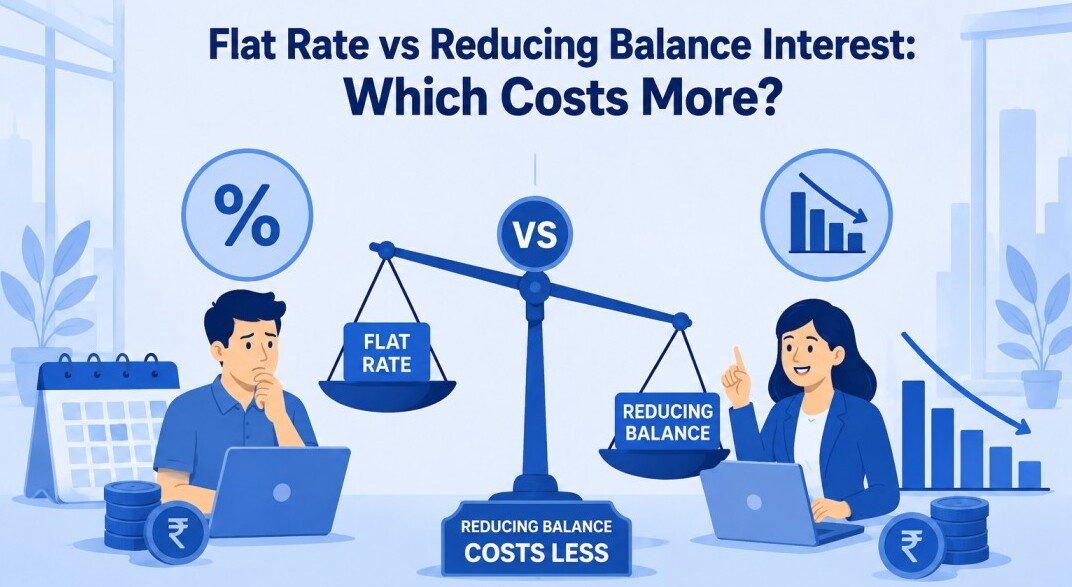
Key takeaways
- Flat rate interest is calculated on the full original loan amount for the entire tenure — even as you repay principal
- Reducing balance interest is calculated only on your outstanding principal, which shrinks every month as you repay
- A 10% flat rate loan can have an effective interest cost close to 18–19% under reducing balance terms — nearly double what the headline number suggests
- Home loans, and most car and personal loans from banks and established NBFCs, generally use reducing balance — but some smaller ticket-size loans and older products still quote flat rates
- Longer tenures widen the gap between flat and reducing balance costs even further, since interest compounds on the full principal for more months
- Always ask a lender directly which method they use — a lower headline rate under flat terms can cost more than a higher reducing balance rate
Quick answer
Flat rate charges interest on your full original loan amount for the whole tenure. Reducing balance charges interest only on what you still owe. For the same headline percentage, flat rate almost always costs significantly more — often 1.8x to 2x the equivalent reducing balance rate. For the basics of how EMI itself works before diving into this comparison, see our guide to what EMI means.
The core difference between the two methods
Both methods sound similar when a lender quotes them as a single percentage. The actual cost to you can be very different.
Flat rate interest
Interest is calculated once, on your original loan amount, and that same interest amount applies for every month of the loan — regardless of how much principal you've already repaid.
Reducing balance interest (also called diminishing balance)
Interest is recalculated every month, based only on your outstanding principal. As you repay principal, next month's interest charge shrinks.
Common mistake: assuming a lower quoted rate always means a cheaper loan. A 10% flat rate loan can cost more in total interest than a 15% reducing balance loan over the same tenure — the calculation method matters as much as the number itself.
Try the EMI Calculator
Compare your actual EMI and total interest under different rate assumptions.
How this actually caught someone off guard
Sanjay wanted to buy a ₹80,000 laptop and the store's financing partner offered a loan at what was advertised as "9% interest" over 2 years. It looked cheaper than the 13% personal loan his bank had offered him, so he almost went with the store's financing without a second thought.
Before signing, he asked the finance rep one direct question: "Is this a flat rate or reducing balance rate?" The answer was flat rate — meaning the real, reducing-balance-equivalent cost worked out closer to 17% a year, actually more expensive than his bank's 13% offer, not less.
Sanjay took the bank's reducing balance loan instead, and ended up paying several thousand rupees less in total interest over the two years — purely because he asked one question before comparing headline numbers.
A worked comparison
Take a ₹5,00,000 loan over 5 years (60 months), comparing a 10% flat rate against an equivalent reducing balance scenario.
Annual flat interest: ₹50,000 (10% of ₹5,00,000, unchanged every year)
Total interest over 5 years: ₹2,50,000
Total repayment: ₹7,50,000
✅ On paper, this looks like a straightforward 10% cost. But because interest never reduces even as you repay principal, the effective annual rate works out closer to 18–19% under reducing balance terms — the same trap Sanjay nearly walked into above, just at a larger scale.
| Metric | 10% flat rate |
|---|---|
| Quoted rate | 10% p.a. |
| Effective rate (reducing balance equivalent) | ~18–19% p.a. |
| Total interest, ₹5L over 5 years | ₹2,50,000 |
Why the gap between quoted and effective rate is so large
Under flat rate, you're paying interest on money you've already returned to the lender.
By month 30 of a 60-month flat rate loan, you've repaid half your principal — but you're still being charged interest as if you owed the full original amount.
Expert tip: as a rule of thumb, a flat interest rate roughly translates to an effective reducing balance rate of about 1.8x to 1.9x the flat number, for typical tenures of 3–5 years. This isn't an exact formula, but it's a useful gut-check when comparing offers — it's roughly the mental maths that would have flagged Sanjay's "9%" offer as actually closer to 17% before he even asked the rep directly.
The actual formulas, side by side
You don't need to run these calculations by hand — an EMI calculator does it instantly — but seeing the formulas explains why the gap between the two methods is so large. For the full breakdown of the reducing balance formula itself with worked examples, see our EMI formula guide.
Flat rate interest formula
Total interest = Principal × Rate × Tenure (in years)
EMI = (Principal + Total interest) ÷ Number of months
Notice that the principal used in this formula never changes — it's the original loan amount, used identically in month 1 and in the final month.
Reducing balance interest formula
EMI = [P × R × (1+R)N] ÷ [(1+R)N − 1]
Where P = principal, R = monthly interest rate, N = number of monthly instalments
Each month, the interest portion of your EMI is calculated only on the remaining principal, and this outstanding balance keeps shrinking with every payment — which is exactly why the effective cost stays much closer to the quoted rate under this method.
How tenure widens the gap
The longer your loan tenure, the bigger the effective-rate gap between flat and reducing balance, since you keep paying interest on the full original amount for more and more months even as your true outstanding balance keeps falling.
| Tenure | Approx. effective rate on a 10% flat loan |
|---|---|
| 2 years | ~17–18% p.a. |
| 5 years | ~18–19% p.a. |
| 7 years | ~19–20% p.a. |
Important: these are approximate, illustrative ranges based on typical loan structures — the exact effective rate for any specific loan depends on its precise repayment schedule and should be verified using an EMI calculator or lender-provided amortization schedule.
Does loan amount change the flat-vs-reducing balance gap?
The percentage gap between flat and reducing balance stays roughly consistent regardless of loan size, but the rupee amount at stake scales up significantly — which is why the method matters even more on larger loans.
| Loan amount (5-yr tenure, 10% flat) | Approx. extra interest vs reducing balance |
|---|---|
| ₹2,00,000 | Roughly ₹50,000–60,000 more |
| ₹5,00,000 | Roughly ₹1.2–1.4 lakh more |
| ₹10,00,000 | Roughly ₹2.5–2.8 lakh more |
✅ On a ₹10 lakh loan, choosing (or being defaulted into) a flat rate structure instead of reducing balance can mean paying an extra amount close to a quarter of the original loan — money that could otherwise go toward an emergency fund, SIP, or faster prepayment.
Which loan types typically use which method
| Loan type | Common method |
|---|---|
| Home loans | Reducing balance (near-universal) |
| Car loans (organised lenders) | Reducing balance, usually |
| Personal loans (banks/NBFCs) | Reducing balance, mostly |
| Some consumer durable/small-ticket loans | Flat rate, sometimes |
| Some gold loans and short-tenure NBFC products | Flat rate, occasionally |
Always confirm directly. Lenders are not always upfront about which method they use, especially for smaller-ticket consumer loans marketed with an attractively low headline rate — exactly the situation Sanjay was in above. Ask explicitly: "Is this a flat rate or reducing balance rate?" before signing anything.
How to spot a flat rate offer in disguise
Flat rate loans are rarely advertised as "flat rate" outright — the framing usually emphasizes how low the headline number sounds. A few patterns are worth watching for:
- A rate that seems unusually low compared to competing offers for the same loan type — this alone was Sanjay's first clue
- Marketing language like "flat interest," "fixed on original amount," or "add-on rate," which are common synonyms for flat rate
- An EMI that stays exactly identical for the full tenure with no amortization schedule shown
- Short-tenure consumer durable or small-ticket loans, where flat rate is more commonly used than for larger loans like home or car loans
How to compare loan offers correctly
- Ask the lender directly whether the quoted rate is flat or reducing balance
- If flat, ask for the equivalent reducing balance rate, or calculate it using an EMI calculator to reverse-engineer the effective rate
- Compare the total interest paid over the full tenure, not just the headline percentage
- Request a full amortization schedule so you can see exactly how much of each EMI goes toward principal versus interest
- Check for processing fees and other charges, which affect the true cost separately from the interest method
Expert tip: when in doubt, compare the total rupee amount of interest paid over the full loan tenure across offers, rather than comparing headline percentages. Total interest paid is method-agnostic and gives you a true apples-to-apples comparison regardless of how each lender calculates their rate. Our EMI calculator guide walks through exactly how to pull this comparison together.
What to do if you're already in a flat rate loan
If you've already taken a flat rate loan and realize it's costing more than expected, a few options can help reduce the impact:
- Prepay aggressively where allowed: since flat rate interest is charged on the full original principal regardless of prepayments, check whether your loan permits partial prepayment and whether it reduces future interest under your specific agreement — our guide to how prepayment saves money covers this in more depth for reducing balance loans
- Refinance with a reducing balance lender: if the outstanding tenure is long enough, switching to a reducing balance loan with a different lender can meaningfully lower your total interest cost, after accounting for any foreclosure or processing charges
- Negotiate with your existing lender: some lenders may offer a conversion or restructuring option, though this varies significantly by institution and loan type
Quick glossary of related terms
| Term | What it means |
|---|---|
| Flat rate / add-on rate | Interest charged on the full original principal for the whole tenure |
| Reducing / diminishing balance | Interest recalculated monthly on the outstanding principal only |
| Effective interest rate | The true annualized cost of a loan once the calculation method is accounted for |
| Amortization schedule | A month-by-month breakdown of how much of each EMI goes to principal vs interest |
| Add-on interest | Another name for flat rate interest, common in consumer durable loan marketing |
Frequently asked questions
What is the difference between flat rate and reducing balance interest?
Flat rate interest is calculated on your full original loan amount for the entire tenure, even as you repay principal. Reducing balance interest is recalculated monthly based only on your remaining outstanding principal, so it shrinks as you repay. For the same headline percentage, flat rate almost always costs more.
Why does a 10% flat rate cost more than a 10% reducing balance rate?
Under flat rate, you keep paying interest on the full original loan amount every year, even though you've already repaid a portion of it. Under reducing balance, interest only applies to what you actually still owe. This makes a 10% flat rate roughly equivalent to an 18–19% reducing balance rate for a typical 3–5 year tenure — this is exactly the gap that caught Sanjay off guard in the example above.
How do I know which method my loan uses?
Ask your lender directly — it's not always stated clearly in marketing materials. Home loans, and most personal and car loans from banks and established NBFCs, generally use reducing balance. Some smaller consumer durable loans still use flat rate, often advertised with an appealingly low headline number, just like the laptop financing offer in the example above.
Is reducing balance always better for the borrower?
For the same quoted percentage, yes — reducing balance always costs less in total interest than flat rate, since you're not paying interest on principal you've already repaid. The comparison only gets tricky when lenders quote different numbers for each method; that's when you need to convert both to an effective rate to compare fairly.
Can I convert a flat rate loan to reducing balance after taking it?
Generally no — the interest calculation method is fixed in your loan agreement from the start. If you're stuck with an expensive flat rate loan, your main options are prepaying aggressively to reduce total interest paid, or refinancing with a different lender offering reducing balance terms, where feasible.
Does loan tenure affect the flat-vs-reducing balance gap?
Yes. Longer tenures generally widen the effective-rate gap, since you keep paying interest on the full original principal for more months even as your true outstanding balance keeps falling. Shorter tenures narrow the gap somewhat, but flat rate still typically costs more than the equivalent reducing balance rate.
What is an "add-on rate" — is it the same as flat rate?
Yes, "add-on rate" is another common term for flat rate interest — the interest is "added on" to the principal upfront and divided evenly across the tenure, rather than being recalculated on a shrinking balance. If you see this term in a loan offer, treat it the same way you would a flat rate quote.
What's the one question I should ask a lender to avoid getting caught out?
"Is this a flat rate or a reducing balance rate?" — this single question is what turned Sanjay's decision around in the example above, revealing that a seemingly cheaper "9%" offer was actually more expensive than a 13% reducing balance loan.