




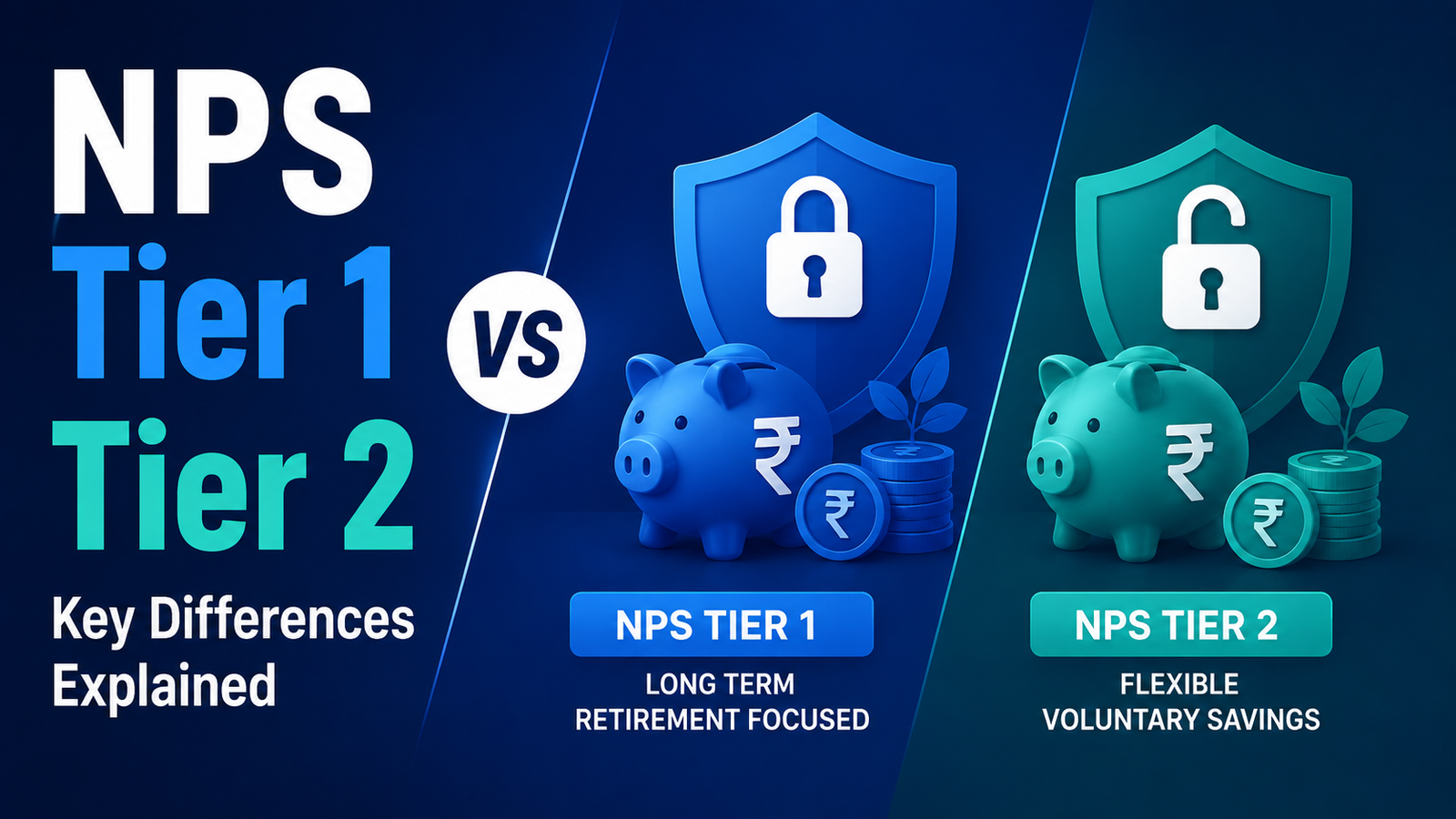
Key takeaways
- Tier 1 is the primary NPS retirement account — mandatory, locked in until retirement, and eligible for tax deductions
- Tier 2 is a voluntary add-on account with no lock-in and full withdrawal flexibility, but no default tax benefit for most subscribers
- You must have an active Tier 1 account before you can open a Tier 2 account
- Tier 1 offers deductions under Section 80CCD(1B) (up to ₹50,000) and 80CCD(1)/80CCD(2) — Tier 2 offers a tax deduction only for specific government employees under a particular lock-in condition
- Tier 2 functions more like a flexible investment account than a retirement account, despite being part of the same NPS structure
Quick answer
Tier 1 is your actual retirement account — locked in until age 60, with meaningful tax deductions, and the account most people mean when they say "NPS." Tier 2 is an optional, flexible add-on with no lock-in and no restrictions on withdrawal, but it generally doesn't carry tax benefits for private-sector or self-employed subscribers, functioning more like a market-linked savings account layered on top of your NPS relationship.
Tier 1 vs Tier 2: side by side
| Feature | Tier 1 | Tier 2 |
|---|---|---|
| Nature | Mandatory primary retirement account | Optional add-on account |
| Lock-in | Until age 60 (with partial withdrawal exceptions) | None — withdraw anytime |
| Tax deduction | Yes — 80CCD(1), 80CCD(1B), 80CCD(2) | Generally none, except a specific case for government employees with a 3-year lock-in |
| Minimum contribution to open | ₹500 | ₹1,000 (only after Tier 1 is active) |
| Minimum annual contribution | ₹1,000/year | No mandatory minimum after opening |
| Withdrawal at maturity | 60% tax-free lump sum; 40% mandatory annuity purchase | Full amount withdrawable anytime, no annuity requirement |
Try the NPS Calculator
Use the NPS Calculator to project your Tier 1 retirement corpus based on your contribution and expected returns.
Tax benefits: the biggest practical difference
This is usually the deciding factor for most people comparing the two.
| Section | Applies to | Deduction limit |
|---|---|---|
| 80CCD(1) | Tier 1 — employee's own contribution | Up to 10% of salary, within overall 80C ₹1.5 lakh cap |
| 80CCD(1B) | Tier 1 — additional voluntary contribution | Up to ₹50,000, over and above the 80C cap |
| 80CCD(2) | Tier 1 — employer's contribution | Up to 10-14% of basic salary, depending on sector, available under both tax regimes |
| Tier 2 | Generally none for private-sector/self-employed subscribers | Central government employees can claim deduction under 80C for Tier 2 contributions locked in for 3 years |
The Tier 2 tax benefit is narrow. It applies specifically to central government employees contributing to Tier 2 under a scheme with a mandatory 3-year lock-in for that specific deduction. For most private-sector employees and self-employed individuals, Tier 2 contributions carry no tax deduction at all — it's essentially a flexible investment account, not a tax-saving one.
Withdrawal rules compared
Tier 1
- At retirement (60): up to 60% can be withdrawn as a tax-free lump sum; the remaining 40% must be used to purchase an annuity, which provides regular pension income.
- Before retirement: partial withdrawal is allowed only for specific purposes (higher education, medical treatment, home purchase) and only after 3 years of being in the scheme, subject to a cap on how much of your own contributions can be withdrawn.
- Premature exit (before 60): allowed only under specific conditions, with a larger portion mandatorily used to buy an annuity than at normal retirement.
Tier 2
- No lock-in at all — funds can be withdrawn partially or fully, anytime, for any reason, similar to a mutual fund.
- No annuity requirement on withdrawal.
A worked example
Rohan, a private-sector employee, contributes ₹50,000/year to Tier 1 under Section 80CCD(1B), reducing his taxable income by the full amount — a direct tax saving on top of his regular 80C investments.
He also opens a Tier 2 account and invests ₹2,000/month there as a flexible, market-linked savings option — he can withdraw this anytime he needs it, but gets no tax deduction on these contributions, and any gains are taxed based on the underlying scheme's asset allocation, similar to a mutual fund.
He treats Tier 1 purely as his long-term retirement account and Tier 2 as a slightly higher-return alternative to keeping surplus cash in a savings account.
Which one should you actually use?
Tier 1 first, always — it's mandatory to access NPS at all, and the tax deductions (especially the extra ₹50,000 under 80CCD(1B)) make it one of the more efficient tax-saving instruments available. Tier 2 is worth considering only as a secondary, flexible investment option — useful if you want NPS-style market exposure without a lock-in, but not a substitute for Tier 1's retirement-focused structure or tax benefits.
Frequently asked questions
Can I open a Tier 2 account without a Tier 1 account?
No. A Tier 1 account must be active first — Tier 2 is only available as an add-on to an existing Tier 1 NPS account.
Does Tier 2 have any tax benefit?
Generally no, for private-sector employees and self-employed subscribers. Central government employees can claim a deduction under Section 80C for Tier 2 contributions, but only if locked in for a minimum 3-year period under that specific scheme.
Is Tier 2 as good as a mutual fund for flexible investing?
It's structurally similar — market-linked, no lock-in, withdrawable anytime — but with a narrower range of fund manager choices than the broader mutual fund market, and generally lower expense ratios. Whether it's "as good" depends on your specific fund choices and comparison.
Can I withdraw my entire Tier 1 balance at retirement?
Only up to 60% can be withdrawn as a tax-free lump sum. The remaining 40% is mandatorily used to purchase an annuity, which then pays you a regular pension income.
Can I move money from Tier 2 into Tier 1?
There's no direct fund-transfer facility between the two — Tier 2 withdrawals are paid out to your bank account, and you'd need to separately contribute that amount into Tier 1 if you wanted it there, subject to Tier 1's usual rules and limits for claiming any deduction on that fresh contribution.
Can I close my Tier 2 account without closing Tier 1?
Yes, Tier 2 can be closed independently at any time, since it has no lock-in and isn't mandatory to keep once opened. Closing Tier 2 has no effect on your Tier 1 account, contributions, or tax benefits.
Which fund managers and asset allocation options are available in Tier 2?
Tier 2 offers the same range of PFRDA-registered pension fund managers and similar equity/corporate bond/government securities allocation choices as Tier 1, so you can choose a similar risk profile in both accounts if you want consistency between them.
How to open a Tier 2 account, step by step
| Step | What to do |
|---|---|
| 1 | Confirm you have an active Tier 1 NPS account with a valid PRAN (Permanent Retirement Account Number) |
| 2 | Log into the eNPS portal or your Tier 1 account provider's platform using your existing PRAN and credentials |
| 3 | Select the option to activate Tier 2, and make the minimum initial contribution (₹1,000) |
| 4 | Choose your fund manager and asset allocation (active or auto-choice), which can differ from your Tier 1 selections if you prefer |
| 5 | Link your bank account for future contributions and withdrawals, which typically process within a few business days of request |
No separate KYC is usually needed if your Tier 1 account is already active and verified — Tier 2 activation typically reuses your existing NPS KYC and PRAN, making it a quick add-on rather than a fresh account-opening process.
Common mistakes with NPS Tier 1 and Tier 2
- Assuming Tier 2 gets the same tax benefit as Tier 1: this is one of the most common misunderstandings — for the vast majority of subscribers (anyone other than central government employees under the specific 3-year lock-in scheme), Tier 2 contributions get no deduction at all.
- Treating Tier 1 as a flexible savings account: because Tier 1 is locked in until 60 with limited partial-withdrawal exceptions, using it for anything other than long-term retirement planning can leave you without access to funds when you actually need them.
- Not reviewing the asset allocation as retirement approaches: Tier 1's auto-choice option gradually reduces equity exposure with age, but subscribers using active choice need to manually rebalance — forgetting to do this can leave a portfolio riskier than intended close to retirement.
- Overlooking Tier 2 as a parking spot for surplus cash: some investors use Tier 2 purely as a flexible, relatively low-cost investment account for money they don't need immediately, similar to how others might use a mutual fund — this is a legitimate use, but it's worth remembering it isn't a retirement-dedicated account the way Tier 1 is.