




Key takeaways
- Gratuity is a one-time thank-you payment from your employer for years of service — not part of your monthly salary
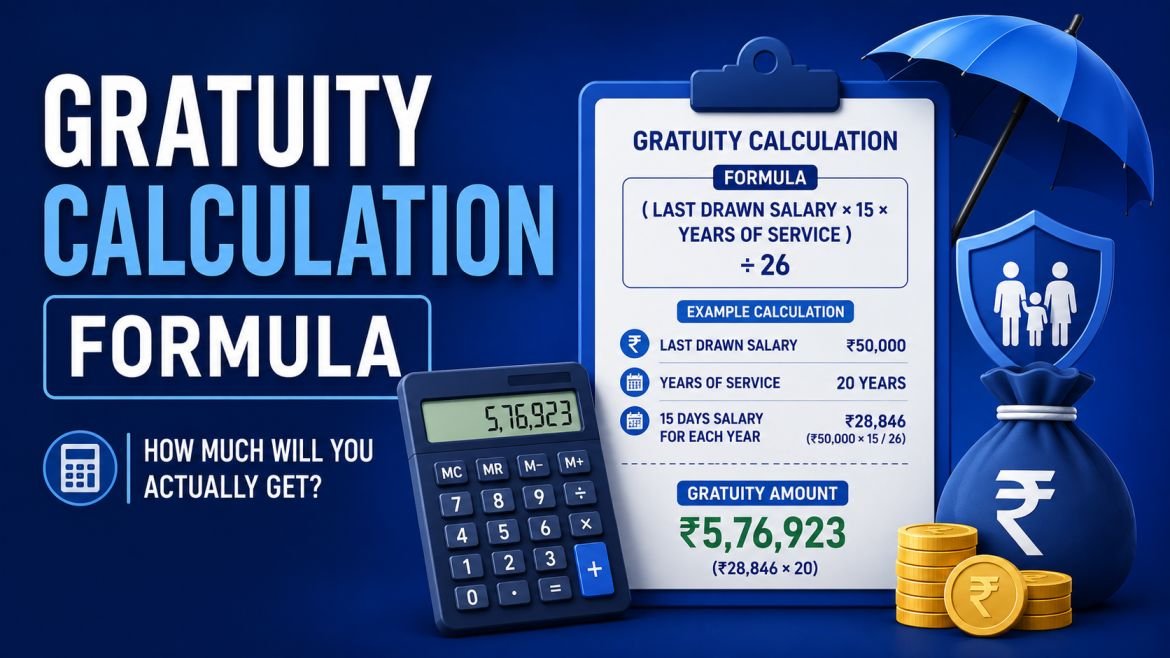
- The gratuity calculation formula in India is: (15 x last drawn salary x years of service) / 26, for employees covered under the Payment of Gratuity Act, 1972
- You generally need at least 5 years with the same employer before you can claim it — quitting at 4 years usually means nothing
- "Last drawn salary" means basic pay + dearness allowance only — bonuses, HRA, and other allowances don't count
- Worked 10 years and 7 months? That gets rounded up to 11 years for the calculation. 10 years and 4 months rounds down to 10
- Gratuity is tax-free up to a government-notified ceiling, which is revised periodically — worth checking the current limit rather than assuming
What is gratuity, in plain terms?
Think of gratuity as your employer's way of saying "thank you for sticking around." It's a lump-sum amount paid to you when you leave a job — whether you resign, retire, or are let go — as long as you've put in enough years of service. It isn't part of your monthly take-home pay; it sits quietly in the background and gets paid out only when you exit.
Most people only think about gratuity when they're about to leave a job, and by then the formula suddenly matters a lot. So let's work through it with a real example, the way you'd actually calculate it for yourself.
The gratuity calculation formula in India
For most private-sector employees, here's the formula:
Gratuity = (15 x Last Drawn Salary x Years of Service) / 26
"Last drawn salary" means your basic pay plus dearness allowance (DA) — not your full CTC. And 26 is simply the number of working days the Act counts in a month, since Sundays are left out.
Try the Gratuity Calculator
Skip the manual math — enter your salary and years of service to get your exact gratuity amount instantly.
A real-life example: Priya's gratuity
Let's say Priya works at a mid-sized private company. Her basic pay + DA is ₹60,000/month, and she's been there for 12 years and 7 months when she decides to switch jobs.
Last drawn basic + DA: ₹60,000/month
Years of service: 12 years 7 months → rounded up to 13 years (more on this rounding rule below)
Gratuity = (15 x 60,000 x 13) / 26
Gratuity = ₹4,50,000
That's roughly seven and a half months of her basic salary, paid out as a single lump sum when she leaves — on top of her final salary, leave encashment, and anything else due to her.
Does your company even have to pay gratuity?
This is the part most people skip, and it matters. Whether you get gratuity — and which formula applies — depends on whether your employer is "covered" under the Payment of Gratuity Act, 1972.
| Type of employer | Covered under the Act? | Formula used |
|---|---|---|
| Factories, mines, plantations | Yes | 15/26 basis |
| Any shop or company with 10+ employees at any point in the last year | Yes | 15/26 basis |
| Once covered — even if headcount later drops below 10 | Yes, stays covered | 15/26 basis |
| Small businesses that have never crossed 10 employees | No | 15/30 basis |
In plain English: if you work at almost any mid-sized or large Indian company, you're covered. If you're not sure, your appointment letter or HR policy document will usually say so directly — or just ask HR, it's a completely normal question to ask before you resign.
What if your employer isn't covered?
Gratuity isn't legally compulsory in that case — but plenty of smaller companies still choose to pay it, usually with a slightly different formula:
Gratuity = (15 x Last Drawn Salary x Years of Service) / 30
The only change is the divisor: 30 instead of 26. This means the same salary and same years of service will actually give you a smaller gratuity amount here, purely because of that one number.
Last drawn basic + DA: ₹60,000/month
Years of service: 13 years
Gratuity = (15 x 60,000 x 13) / 30
Gratuity = ₹3,90,000
That's ₹60,000 less than Priya's covered-employee calculation — same salary, same tenure, only the formula changed.
Gratuity eligibility rules: when can you actually claim it?
This is where most confusion — and most disappointment — happens. Here's what actually determines whether you're eligible:
- You generally need 5 full years with the same employer. Resign at 4 years and 9 months, and in most cases you walk away with nothing, no matter how good your performance reviews were.
- The "4 years 240 days" exception: in several court cases, an employee who completed 4 years and 240 days was treated as having met the 5-year mark. It's a real precedent, but not a guarantee — don't plan your resignation date around it without checking with HR or a labour law professional first.
- Death or disablement waives the 5-year rule entirely. If an employee passes away or becomes disabled before completing 5 years, their nominee or legal heir still receives gratuity — tenure doesn't matter in this case.
- Approved leave, layoffs, or a strike don't break your "continuous service." Taking sanctioned leave or being affected by a lockout that wasn't your fault doesn't reset your years-of-service clock.
The mistake people make: assuming gratuity gets paid out at any exit, for any reason. If you resign before hitting 5 years — and it isn't due to death or disablement — you're generally not eligible. This catches a lot of people off guard when they're job-hopping early in their careers.
How partial years actually get counted
Real careers rarely end on a clean, whole-number anniversary — so the Act has a simple rounding rule:
- More than 6 months in your final year? It rounds up to the next full year.
- 6 months or less? It rounds down, and only your completed years count.
10 years and 7 months of service → counted as 11 years
10 years and 4 months of service → counted as 10 years
This is exactly why Priya's 12 years 7 months became 13 years in her calculation earlier — it's not a rounding mistake, it's how the formula is designed to work.
Do you have to pay tax on your gratuity?
Good news if you work for the government: your gratuity is fully tax-free, no conditions attached.
If you're in the private sector and your employer is covered under the Act, your gratuity is tax-exempt up to whichever is lowest of these three:
- The actual gratuity amount you received
- 15 days' salary for every completed year of service (using the 15/26 formula)
- A maximum ceiling set by the government, which gets revised from time to time
Worth checking before you assume anything is fully tax-free: that government ceiling changes periodically, so don't rely on a number you saw in an old article or forwarded WhatsApp message. Whatever you receive above that ceiling gets taxed as regular salary income in the year you receive it.
Covered vs non-covered, side by side
| What changes | Covered under the Act | Not covered |
|---|---|---|
| Formula's divisor | 26 | 30 |
| Is it compulsory? | Yes, once you're eligible | No — entirely up to the employer |
| Salary used | Last drawn basic + DA | Often the average of your last 10 months' basic + DA |
| Tax-free up to a ceiling? | Yes, government-notified | Yes, but calculated a bit differently |
Frequently asked questions
What is the gratuity calculation formula in India?
For employees at companies covered under the Payment of Gratuity Act, 1972, it's (15 x last drawn salary x years of service) / 26 — where "last drawn salary" means your basic pay plus dearness allowance, nothing else. Employees at non-covered companies typically see a divisor of 30 instead of 26.
How many years do I need to work to get gratuity?
Usually a minimum of 5 years of continuous service with the same employer, whether you resign or retire. This rule doesn't apply if employment ends because of the employee's death or disablement — gratuity is paid regardless of how long they'd worked.
Is gratuity calculated on my full CTC or just my basic salary?
Just your last drawn basic salary plus dearness allowance (DA). Your HRA, bonuses, special allowances, and other CTC components don't factor into the calculation at all — which surprises a lot of people who assume it's based on their full salary slip.
Do I have to pay tax on gratuity in India?
Government employees get it fully tax-free. Private-sector employees at covered companies get it tax-free up to the lowest of: the amount actually received, 15 days' salary per completed year of service, or a government-set ceiling that's revised periodically. Anything above that ceiling is taxed as salary income.
I worked 8 years and 5 months. Does that count as 8 or 9 years for gratuity?
It counts as 8 years. The rounding rule only rounds up if you've crossed 6 months in your final year — 5 months falls short, so it rounds down and only your completed years are used in the calculation.
Can I get gratuity if I resign before 5 years?
In most cases, no — 5 years of continuous service is the standard cutoff for resignation-based claims. The exceptions are death or disablement, where gratuity is paid regardless of tenure, and a narrower court-recognised exception around 4 years and 240 days, which isn't guaranteed and is worth confirming with HR before you rely on it.
One last thing to keep in mind: this article covers the standard formula under the Payment of Gratuity Act, 1972. Your specific company policy, state-level rules, or an unusual exit situation (like the "4 years 240 days" case) can change what you're actually entitled to. If your situation isn't straightforward, it's worth a quick conversation with your HR team or a labour law professional rather than relying on the formula alone.