




Key takeaways
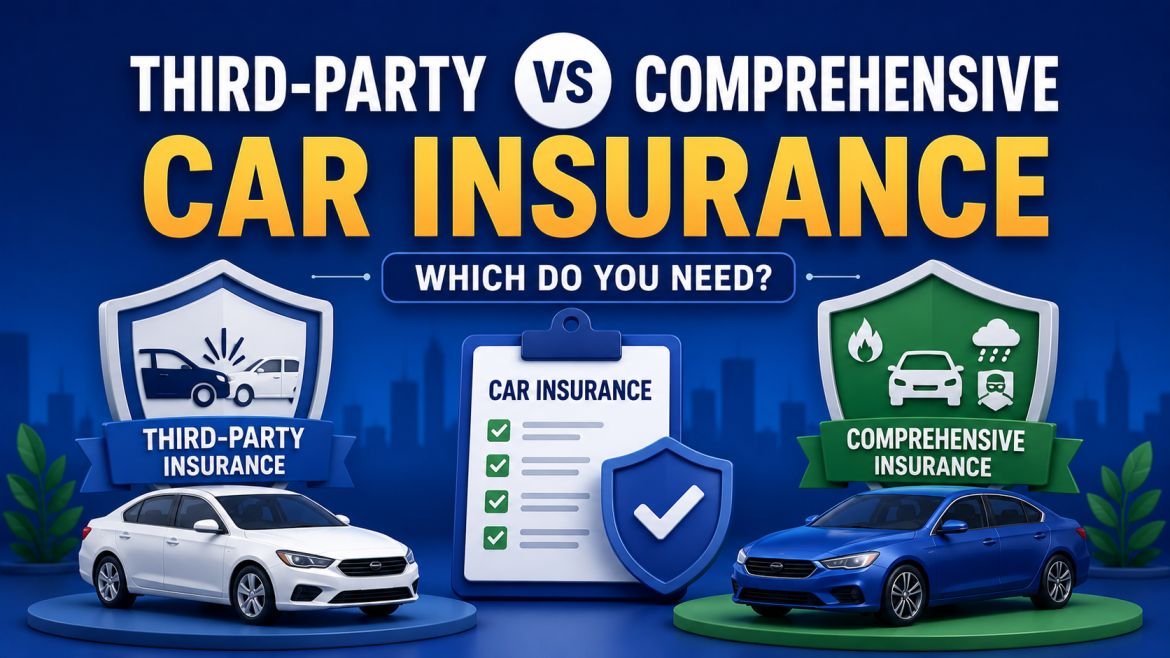
- Third-party insurance is legally required for every vehicle on Indian roads. Comprehensive cover is optional, but protects much more
- Third-party only pays for damage or injury you cause to someone else — it pays nothing if your own car gets damaged
- Comprehensive cover includes third-party liability, plus damage to your own car from accidents, theft, fire, and natural disasters
- Add-ons like zero depreciation and roadside assistance only exist on comprehensive policies, not third-party ones
- If you have a car loan, your lender will almost always require comprehensive cover, not just the legal minimum
Quick answer
Old car, fully paid off, tight budget: third-party cover meets the legal minimum, but you're on your own for any repair bill to your own car.
Newer car, still on a loan, or you actually want real protection: comprehensive cover is almost always worth the extra cost, since it protects the car itself, not just other people.
What's actually different
Third-party car insurance only covers damage or injury you cause to someone else — another car, a person, someone's property. It's legally required for every vehicle driven on Indian roads. Driving without it is a punishable offence.
Comprehensive car insurance covers everything third-party does, plus your own car — accidental damage, theft, fire, and natural disasters like floods or storms — with the option to add even more protection through add-ons.
The gap that catches people off guard: with only third-party cover, if you cause an accident, the other person's damage gets paid — but your own car's repair bill comes entirely out of your own pocket.
What each one actually pays for
- Third-party: injury or death to another person, damage to someone else's property, and the legal liability that comes with it
- Comprehensive: everything above, plus damage to your own car from accidents, theft, fire, vandalism, and natural disasters
| Feature | Third-party insurance | Comprehensive insurance |
|---|---|---|
| Legally required | Yes | No (but usually required by lenders if you have a car loan) |
| Covers third-party damage/injury | Yes | Yes |
| Covers your own car's damage | No | Yes |
| Covers theft of your car | No | Yes |
| Add-ons available (zero depreciation, roadside assistance, etc.) | No | Yes |
| Typical premium | Lower | Higher |
Try the Car Loan Calculator
Financing a car? Check what a comprehensive policy costs against your EMI budget.
How this actually plays out, with numbers
Ananya bought a new car on a loan a year ago. Her lender required comprehensive cover, and she also added zero depreciation cover for about ₹2,500 extra a year. Six months in, another driver sideswipes her car at a signal — her own repair bill comes to ₹85,000.
Because she has comprehensive cover with zero depreciation, the insurer pays the full ₹85,000, with no deduction for worn parts. If she'd only had third-party insurance — legally enough to be on the road — that entire ₹85,000 would have come straight out of her own pocket, since third-party cover only pays for damage she causes to someone else.
Rohit's second car is 11 years old, fully paid off, and worth maybe ₹1.5 lakh on resale. He does the math: a comprehensive policy would cost him roughly ₹8,000 a year, while third-party cover costs closer to ₹2,500. Given the car's low value, he decides the extra ₹5,500 a year isn't worth it — if the car gets seriously damaged, he's more likely to just sell it for parts than repair it anyway.
He sticks with third-party insurance, fully aware he's accepting the repair risk himself. It's a reasonable call for his specific situation — but it's a deliberate trade-off he's chosen, not something he should stumble into without doing the math first.
Useful comprehensive add-ons worth knowing about
Worth knowing: since 22 September 2025, individual life and health insurance premiums carry 0% GST. Motor insurance — both third-party and comprehensive — isn't part of that change and still carries the standard 18% GST on the premium, same as before.
Zero depreciation cover
Normally, when parts are replaced in a claim, the payout is reduced based on how old those parts were — a car's plastic and rubber parts especially lose "value" fast on paper. This add-on removes that deduction, so you get the full repair cost instead. Ananya's example above shows exactly why this matters for a newer car.
Engine protection cover
Standard comprehensive policies usually exclude engine damage caused by water entering the engine — like driving through a flooded street. This add-on specifically covers that gap, which matters a lot if you live somewhere prone to waterlogging.
Roadside assistance
Covers things like towing, a flat tyre, or fuel delivery if your car breaks down somewhere inconvenient — a cost that would otherwise be an unexpected, badly-timed expense.
No-claim bonus (NCB) protection
Normally, making even one claim resets your no-claim bonus — the discount you've built up over years without a claim. This add-on lets you make a limited number of claims without losing that accumulated discount.
Common mistakes to avoid
Common mistake: assuming third-party cover is "enough" just because it's the legal minimum. Being legally compliant and actually protecting your car are two different things — third-party cover only does the first one.
- Letting your policy lapse, which can cost you your accumulated no-claim bonus and mean a fresh inspection before you can get covered again
- Not declaring modifications made to the car, which can complicate or even invalidate a claim later
- Picking the cheapest policy without checking the insurer's claim settlement record and garage network
- Forgetting to transfer the policy — and your NCB — when you sell your car or buy a used one
Myths vs facts
| Myth | Fact |
|---|---|
| Third-party insurance covers my own car's damage too | No — it only covers the other person's damage or injury. Your own car's repairs aren't covered at all, as Ananya's example above shows |
| Comprehensive insurance is only worth it for expensive cars | Even for a modest car, theft and accidental damage can be costly enough that comprehensive cover is usually still worth it, especially with the right add-ons |
| I lose my no-claim bonus forever if I switch insurers | NCB is usually transferable between insurers when you renew or switch, as long as you can show proof of your claim-free history |
Best practices
- Choose comprehensive cover for any car that's on a loan, recently bought, or still has meaningful resale value
- Add zero depreciation and engine protection if you drive a newer car or live somewhere prone to flooding
- Renew before your policy lapses, to protect your accumulated no-claim bonus
- Compare insurers on claim settlement record and garage network — not just on premium
Frequently asked questions
Is third-party car insurance mandatory in India?
Yes. Driving any vehicle on a public road without at least third-party insurance is illegal in India and can attract penalties.
Does comprehensive insurance cover theft of my car?
Yes, theft is typically covered under comprehensive insurance. A third-party-only policy doesn't cover theft of your own car at all.
What is a no-claim bonus (NCB)?
It's a discount on your premium that builds up for every year you don't make a claim, and it can grow substantially over several consecutive claim-free years.
Can I switch from third-party to comprehensive mid-policy?
Generally no, not on the same policy mid-term — but you can choose comprehensive cover when your policy comes up for renewal.
Is zero depreciation cover worth it for an older car?
Usually more valuable on newer cars, since depreciation deductions get larger the older the car is anyway. For an older car, like Rohit's example above, the extra premium may not be worth it.
Do I need comprehensive insurance once my car loan is fully paid off?
It's no longer required by a lender at that point, but it's still worth weighing against your car's value and how comfortably you could absorb a big repair bill yourself — exactly the trade-off Rohit works through in the example above.
What happens if I let my car insurance lapse?
Besides being illegal to drive without at least third-party cover, a lapsed policy usually means losing your accumulated no-claim bonus, and may require a vehicle inspection before a new policy can be issued.
Can I transfer my no-claim bonus when I buy a new car?
Yes, NCB belongs to you as the policyholder, not to the specific car, so it typically transfers to your new car's policy when you upgrade or replace your vehicle.
Does comprehensive insurance cover damage from natural disasters?
Yes, standard comprehensive policies typically include damage from floods, storms, and other natural disasters, though always confirm the specific exclusions and sub-limits with your insurer.
Is engine protection cover included by default in comprehensive insurance?
No, it's usually a separate add-on. Standard comprehensive policies commonly exclude engine damage from water ingression unless you've specifically bought this add-on.