




Key takeaways
- Term insurance premium is locked in at the age you buy the policy — it doesn't increase later during the policy term
- Buying at 25 instead of 35 can mean paying roughly 40-60% less annual premium for the same cover, for the rest of the policy's life
- The increase isn't linear — premiums rise more steeply after age 40-45 as mortality risk increases
- Delaying purchase doesn't just cost more each year you wait — it costs more for every year of the policy after that too
- Health conditions that develop with age (diabetes, hypertension) can further increase premiums or lead to loading/exclusions
Quick answer
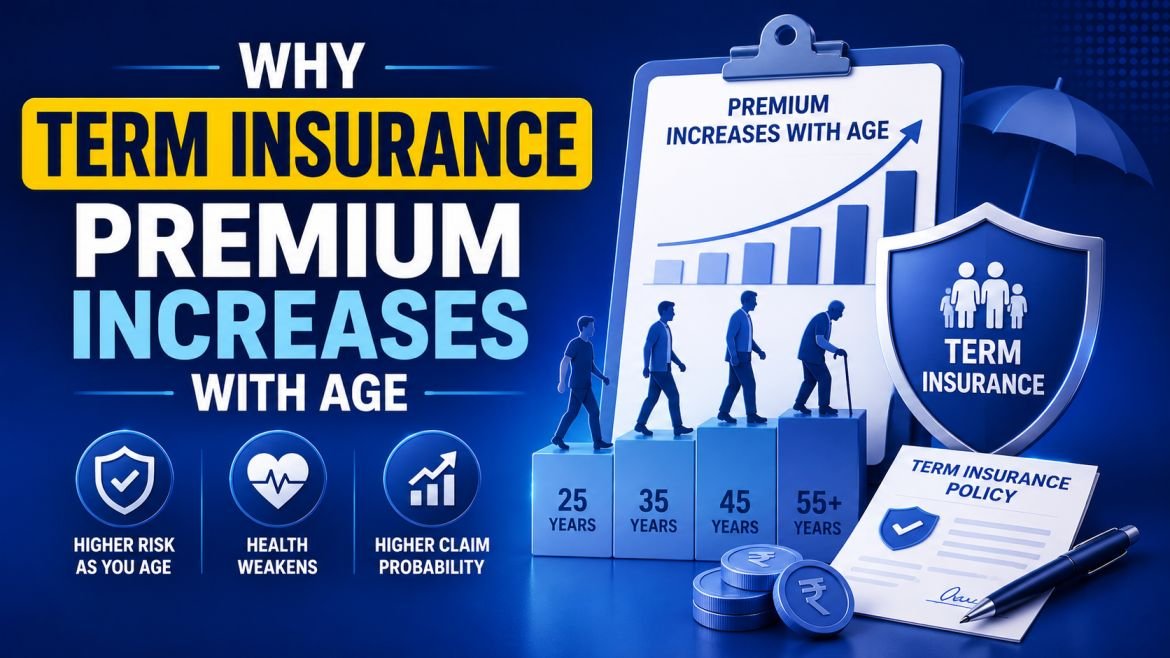
Term insurance premiums rise with age because mortality risk rises with age — insurers charge more to cover a statistically higher chance of a claim. Importantly, once you buy a policy, your premium is locked in for the entire term at the rate for your age when you bought it. This means buying early doesn't just save you money in your 20s — it saves you money every single year for the rest of the policy.
Why age is the single biggest factor in term insurance pricing
Term insurance is priced almost entirely around mortality risk — the statistical likelihood that the insurer will need to pay out a claim during the policy term. As you age, that likelihood rises, particularly for cover extending into your 50s and 60s, so insurers charge a higher premium to compensate.
This isn't insurer discretion — it's actuarial math. All insurers use mortality tables that show statistically how likely a person of a given age is to pass away within a certain period. This directly drives the premium calculation, which is why premiums increase predictably with age across virtually every insurer.
Try the Life Insurance Calculator
Use the Life Insurance Calculator to estimate how much cover you actually need before comparing premiums.
Illustrative premium for ₹1 crore cover by age
These are illustrative figures for a non-smoker, 30-year term, ₹1 crore cover — actual premiums vary by insurer, health, lifestyle, and policy features.
| Age at purchase | Approx. annual premium (₹1 crore cover) | Total premium over policy term |
|---|---|---|
| 25 | ~₹9,000 - 11,000 | ~₹2.7 - 3.3 lakh (30 yrs) |
| 30 | ~₹11,000 - 14,000 | ~₹3.3 - 4.2 lakh (30 yrs) |
| 35 | ~₹15,000 - 19,000 | ~₹4.5 - 5.7 lakh (30 yrs) |
| 40 | ~₹22,000 - 28,000 | ~₹6.6 - 8.4 lakh (30 yrs) |
| 45 | ~₹35,000 - 45,000 | ~₹7 - 9 lakh (20 yrs) |
Notice the jump between age 35 and 45 — the increase isn't a straight line. Premiums accelerate meaningfully in your 40s, which is why financial advisors consistently recommend buying term cover as early as possible, even if the immediate need feels distant.
A worked example: the real cost of waiting
Suppose two people each buy ₹1 crore term cover for a 30-year term — one at age 25, one at age 35.
The 25-year-old locks in roughly ₹10,000/year — paying about ₹3 lakh in total premiums over the policy's 30-year life.
The 35-year-old, buying the same cover 10 years later, locks in roughly ₹17,000/year — about ₹5.1 lakh in total premiums over their 30-year term.
Waiting 10 years to buy the same cover costs roughly ₹2.1 lakh more over the life of the policy — not counting the 10 years the second person went without any cover at all.
Health conditions compound the age effect
Age isn't the only factor that worsens with time — health conditions like diabetes, hypertension, or elevated BMI often develop or get diagnosed later in life. Insurers may respond to these with:
- Premium loading: a higher premium than the standard rate for your age, to account for added risk.
- Exclusions: specific conditions excluded from coverage.
- Medical tests: more extensive underwriting required at higher ages or with pre-existing conditions, which can also delay policy issuance.
Buying young, while healthy, often means simpler underwriting and a "standard" premium rate — before any conditions that could trigger loading or exclusions have had a chance to develop.
So when should you actually buy term insurance?
As soon as you have financial dependents or liabilities — this is typically right when you start earning, take on a home loan, or have someone financially dependent on your income. Waiting for a "better time" almost always means paying more for the same or lesser cover, since both age and potential health changes work against you the longer you wait.
Frequently asked questions
Does my term insurance premium increase every year automatically?
No — for a standard level-term policy, your premium is fixed at the rate for your age at purchase and stays the same for the entire policy term, regardless of how your age or health changes later.
Is it worth buying term insurance in your 20s if you don't have dependents yet?
It can be worth considering if you expect to take on dependents or large liabilities (like a home loan) in the near future, since locking in a lower premium while young and healthy can meaningfully reduce lifetime cost. However, if you have no foreseeable dependents or liabilities, it's a personal financial planning decision rather than a strict necessity.
Can I increase my cover later without it affecting my original premium?
Increasing cover typically means either adding a rider (if available) or buying an additional policy — the new cover amount would be priced at your current age, not your original purchase age. Your existing policy's premium and cover remain unaffected.
Does smoking or tobacco use affect term insurance premiums as much as age does?
Yes, significantly — smokers typically pay 50-100% more than non-smokers for the same cover and age, since insurers treat tobacco use as a major mortality risk factor. Like age, this rate is also generally locked in at purchase, so quitting after buying a policy doesn't usually reduce an existing premium, though some insurers allow a review after a sustained smoke-free period.
What happens to my premium if I develop a health condition after buying the policy?
Nothing — your premium is locked in at purchase and doesn't change even if your health changes later, as long as you disclosed your health status accurately when buying. This is one of the strongest arguments for buying term cover while young and healthy, before any condition could affect either your premium or your ability to get cover at all.
Is a shorter policy term cheaper than a longer one at the same age?
Generally yes — a shorter term (say, 20 years instead of 30) usually has a lower annual premium, since the insurer's total risk exposure is lower. However, a shorter term also means your cover ends earlier, potentially before your dependents are fully financially independent, so the choice should be based on how long you actually need the cover, not just cost.
How riders affect your premium at different ages
Add-on riders extend your policy's coverage beyond a plain death benefit — but they also add to your premium, and that add-on cost tends to compound with the age effect discussed above.
| Common rider | What it covers | Typical premium impact |
|---|---|---|
| Critical illness rider | Lump sum payout on diagnosis of specified critical illnesses | Meaningful addition, and itself rises faster with age than the base premium |
| Accidental death benefit | Additional payout if death is due to an accident | Relatively small addition to premium |
| Waiver of premium | Future premiums waived if you're diagnosed with a disability or critical illness | Small to moderate addition |
| Income benefit rider | Pays out as a monthly income to nominees instead of one lump sum | Restructures payout, minimal premium change |
Riders like critical illness cover are worth adding earlier rather than later for the same reason as the base policy — their cost also increases with age, and some riders have their own age-based eligibility cutoffs that can restrict adding them later even if you're willing to pay more.
Common mistakes when buying based on age
- Waiting for a "more settled" life stage before buying: many people delay buying term insurance until marriage, a child, or a home loan — but each year of delay increases the locked-in premium permanently, regardless of when the actual need arises.
- Under-declaring health or lifestyle habits to get a lower quoted premium: this can lead to claim rejection later, since insurers verify disclosures at the time of a claim, not just at purchase — the short-term premium saving isn't worth the long-term risk to the policy's validity.
- Choosing a term shorter than the actual dependency period: buying a 20-year term at age 30 when your youngest child won't be financially independent until you're 55-58 leaves a coverage gap right when it might still be needed.
- Not comparing across insurers before buying: premiums for the same age, cover, and term can vary meaningfully between insurers, so comparing 3-4 quotes is worth the time before locking in a decades-long premium.