




Key takeaways
- GST can be calculated two ways — added on top of a price, or extracted from a price that already includes it — and mixing these up is the most common invoicing mistake
- Under the current GST rate structure, the working slabs are 0%, 0.25%, 3%, 5%, 18%, and 40%, with the applicable rate depending on the specific goods or service
- Individual life and health insurance premiums are currently Nil-rated under GST
- Within-state sales split GST into CGST + SGST/UTGST (each half the applicable rate); inter-state sales charge IGST (the full rate, to one head)
- Freelancers and small businesses below the applicable GST registration threshold (₹20L for services, ₹40L for goods, ₹10L in special category states) don't need to charge GST at all
- Claiming Input Tax Credit depends on your supplier actually filing their GSTR-1 — not just having a valid invoice in hand
- Filing a return and paying the tax you owe are two separate steps — you generate and pay a challan before your GSTR-3B can be filed cleanly
Quick answer
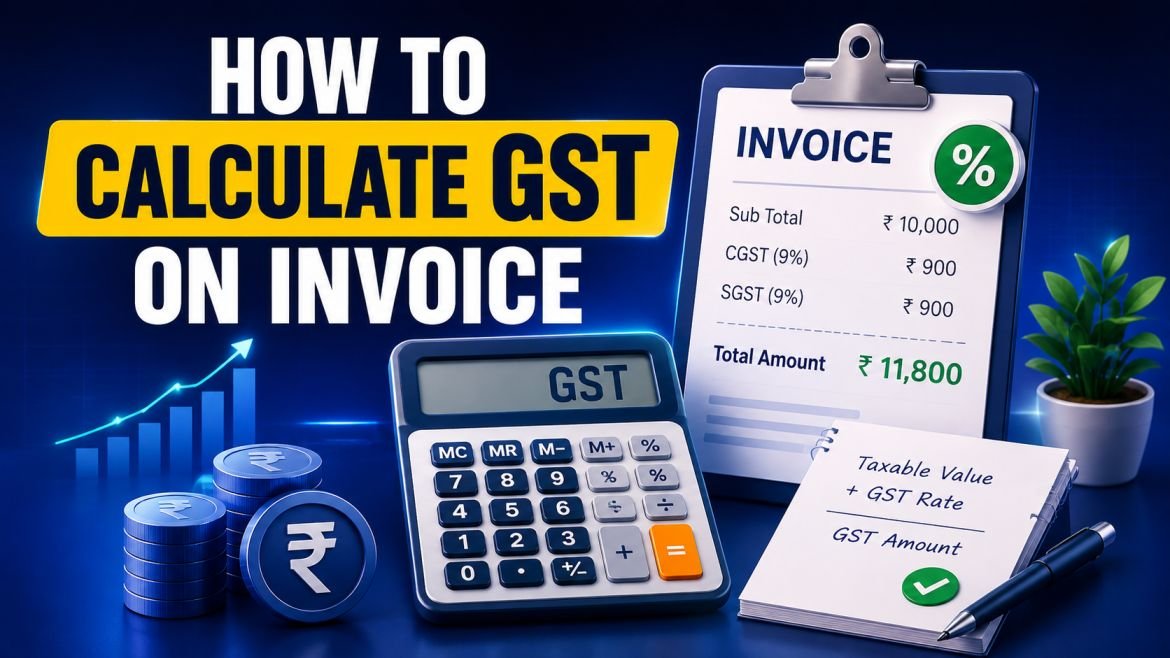
To add GST to a price: GST amount = price × (GST rate ÷ 100), then add it to the price. To extract GST from a price that already includes it: GST amount = price × (GST rate ÷ (100 + GST rate)) — not the same formula, and this is where most invoicing mistakes happen.
A real example: Arjun's first GST invoice
Arjun is a freelance graphic designer who just crossed the GST registration threshold. He quotes clients ₹50,000 for a project and needs to raise his first GST invoice. He isn't sure whether to charge GST on top of ₹50,000, or whether ₹50,000 should already include it — a confusion almost everyone runs into the first time.
Adding GST to a price (exclusive of GST)
If your quoted price is before GST, the calculation is straightforward:
GST amount = ₹50,000 × (18 ÷ 100) = ₹9,000
Total invoice value = ₹50,000 + ₹9,000 = ₹59,000
Since Arjun and his client are in the same state, this ₹9,000 splits into ₹4,500 CGST + ₹4,500 SGST — not ₹9,000 of each.
Extracting GST from a price that already includes it (inclusive of GST)
This is the calculation people get wrong most often. If a price already includes GST — common when a client insists on a fixed "all-in" number — you can't just multiply by the rate to find the GST portion.
Multiplying ₹59,000 × 18% gives ₹10,620 — this is wrong. That would mean the GST-exclusive price is only ₹48,380, which doesn't reconcile.
Correct formula: GST amount = ₹59,000 × (18 ÷ 118) = ₹9,000
Base price (before GST) = ₹59,000 − ₹9,000 = ₹50,000
The denominator is 100 + GST rate, not 100 — that's the detail almost everyone misses.
Common mistake: using price × rate% to extract GST from an inclusive amount, the way Arjun almost did above. This overstates the GST portion and understates the actual base price — a problem that compounds if you're filing returns off numbers calculated this way.
Try the GST Calculator
Switch between Exclusive and Inclusive of GST mode instantly, and see the CGST/SGST or IGST split for any amount.
Current GST rate structure
GST in India is organised into a small set of rate slabs, with the applicable rate depending on the specific goods or service being supplied. Rates are periodically revised by the GST Council, so it's worth confirming the rate for your specific item before invoicing rather than relying on an old bookmark or a cached search result.
| Slab | Typically applies to |
|---|---|
| 0% (Nil/Exempt) | Unbranded fresh essentials, most healthcare, education services, many lifesaving drugs, and individual life & health insurance premiums |
| 0.25% | Rough diamonds and specific precious stones (niche rate) |
| 3% | Gold, silver, precious stones, jewellery (niche rate) |
| 5% | Essential and daily-use goods, packaged food, medicines, medical devices, economy transport, and several personal-care and household items |
| 18% | The standard rate — most goods and services not specifically placed in another slab, including IT/software services, restaurants, telecom, financial services, and most professional services |
| 40% | Luxury and sin goods — items such as aerated/energy drinks, luxury vehicles, tobacco, and pan masala |
Rates change over time. GST slabs and item-to-slab mappings get revised periodically by the GST Council. If you're working from an older invoice template, price list, or guide, double-check the rate currently applicable to your specific product or service on gst.gov.in rather than assuming it still matches what you last used.
Freelancers and service providers: most professional services — design, consulting, IT, marketing — fall under the 18% rate, which is why Arjun's examples above use 18%. Always confirm the rate applicable to your specific service category, since this isn't legal or tax advice.
CGST + SGST vs IGST: which applies to your invoice?
Whether GST splits into two components or stays as one depends entirely on where your client is located relative to you — not on what kind of service or product you're selling.
| Transaction type | Tax charged | Split |
|---|---|---|
| Within the same state | CGST + SGST (UTGST in Union Territories) | Applicable GST rate split equally between the two |
| Between different states | IGST | Full applicable rate, charged as one line |
If Arjun's client were in a different state instead of his own, the same ₹9,000 GST on his ₹50,000 invoice would be charged entirely as IGST — one line, ₹9,000 — instead of splitting into ₹4,500 CGST + ₹4,500 SGST.
Do you even need to register for and charge GST?
Freelancers and small business owners below the applicable GST registration threshold aren't required to register for or charge GST at all:
| Category | Applicable registration threshold (annual turnover) |
|---|---|
| Services (freelancers, consultants, agencies) | ₹20 lakh |
| Goods (traders, manufacturers) | ₹40 lakh |
| Special category states | ₹10 lakh |
If you're not registered: don't add a GST line to your invoice at all. Charging GST without being registered to collect it creates a compliance problem, not a tax benefit. If you're close to the threshold, it's worth tracking your rolling annual turnover rather than finding out after you've crossed it.
The composition scheme — an alternative for small businesses
If your turnover is modest and you'd rather not deal with monthly GST filing and detailed invoicing, the composition scheme lets small businesses and traders pay GST at a lower, fixed rate on turnover instead of the standard slab-based rate — in exchange for giving up Input Tax Credit and the ability to sell inter-state. It's available up to a specific turnover ceiling and isn't available to all business types, so it's worth checking eligibility on gst.gov.in rather than assuming it applies to your situation.
Input Tax Credit (ITC): what it is and why it can go wrong
If you're GST-registered and buy goods or services for your business, you can usually claim the GST you paid on those purchases (input tax) against the GST you collect from your clients (output tax) — paying only the difference. But ITC isn't automatic just because you have a valid-looking invoice.
Common mistake: assuming ITC is guaranteed the moment you receive an invoice. In practice, you can only claim it if your supplier has actually filed their GSTR-1 and the invoice shows up in your GSTR-2B — if they haven't filed, your claim can get blocked or reversed even though you paid GST on a genuine purchase.
GSTR-1 vs GSTR-3B — what's the difference?
| Return | What it covers | Typical due date |
|---|---|---|
| GSTR-1 | Details of your outward supplies (sales) — line-by-line invoice data | 11th of the following month (monthly filers); quarterly under the QRMP scheme |
| GSTR-3B | A summary return declaring total tax liability and paying it | 20th of the following month |
Why both matter to your clients too: if you're late filing GSTR-1, your clients' Input Tax Credit claims (which rely on your invoice appearing in their GSTR-2B) get delayed — a good reason to file on time even beyond your own compliance obligations.
Where and how Arjun actually pays his GST
Calculating and filing are only half the process — the GST itself still has to be paid to the government, and this happens separately from simply submitting a return.
After raising his invoices for the month, Arjun logs into the GST portal to generate a challan for the tax he owes, pays it online, and then files his GSTR-3B referencing that payment. The return and the payment are two connected but distinct steps — filing a return doesn't automatically debit the tax; the payment has to be made first (or alongside it) for the filing to go through cleanly.
The payment process, step by step
- Log in to the GST portal (gst.gov.in) with your GSTIN credentials.
- Generate a challan (Form GST PMT-06) specifying how much you owe under each head — CGST, SGST/UTGST, or IGST — based on your invoices for the period.
- Pay the challan using net banking, a debit/credit card, NEFT/RTGS, or over the counter at an authorised bank, depending on the amount and what your bank supports.
- The amount reflects in your electronic cash ledger on the GST portal, which is separate from your electronic credit ledger (where your Input Tax Credit sits).
- File your GSTR-3B, which draws on both ledgers — your available ITC first, then the cash ledger — to settle your final tax liability for the period.
Cash ledger vs credit ledger: your GST liability is first offset against any Input Tax Credit sitting in your electronic credit ledger; you only need to pay fresh cash for whatever liability remains after that. This is why keeping ITC properly reconciled (see the ITC section above) directly affects how much you actually need to pay in cash each period.
Common mistake: waiting until the GSTR-3B due date to generate and pay the challan. Since the return can't be filed until the corresponding tax is paid, leaving this to the last day risks a late filing (and the interest that comes with it) if the payment or bank processing takes longer than expected.
E-invoicing and e-way bills — do these apply to you?
- E-invoicing is mandatory once your turnover crosses the applicable e-invoicing threshold (currently ₹5 crore) — every invoice needs an Invoice Reference Number (IRN) generated before it's issued. Most freelancers and small businesses fall well below this threshold and don't need to worry about it.
- E-way bills are required when goods worth more than the applicable e-way bill limit (currently ₹50,000) move across state borders (and in some cases within a state). This applies to goods movement specifically — it generally doesn't apply to service invoices like Arjun's design work, which involves no physical goods in transit.
HSN and SAC codes: why your invoice needs one
Every GST invoice needs a code identifying what's being sold — HSN codes for goods, SAC codes for services. These aren't optional labelling; they determine which GST rate legally applies to that specific line item, and mismatched or missing codes are a common reason invoices get questioned during reconciliation or audit. If you're unsure which code applies to your specific service or product, checking an HSN/SAC code lookup directly against your invoice description before issuing it is worth the extra minute.
Why rounding matters more than you'd think
GST amounts should be rounded to the nearest rupee on the final invoice value, but doing this inconsistently across line items on a multi-item invoice can cause the total to not reconcile exactly with rate × base price when checked later. Calculating GST on the invoice total rather than rounding each line item separately usually avoids this.
Common GST invoicing mistakes
Applying the wrong formula for inclusive prices: using price × rate instead of price × (rate ÷ (100 + rate)) when GST is already included — Arjun's near-mistake above.
Charging CGST+SGST for an inter-state sale, or vice versa: this depends on client location, not on the nature of the service, and getting it backwards is a common filing error.
Charging GST without being registered: if you're below the threshold and not registered, adding a GST line to your invoice isn't optional extra income — it's not something you're entitled to collect.
Assuming ITC is automatic: your claim depends on your supplier actually filing their GSTR-1 on time — a valid invoice alone doesn't guarantee it.
Waiting until the last day to pay: the GSTR-3B can't be filed until the corresponding challan is paid, so generating and paying it close to the deadline risks a late filing if there's any delay.
Using an outdated rate: GST rates and item-to-slab mappings are revised from time to time. Double-check the rate currently applicable to your category rather than relying on an old bookmark or a cached search result.
Frequently asked questions
How do I calculate GST if the price already includes it?
Use GST amount = price × (GST rate ÷ (100 + GST rate)) — not price × rate%, which overstates the GST portion. Subtract that GST amount from the inclusive price to get the base price, as shown in Arjun's example above.
What's the difference between CGST, SGST, and IGST?
CGST and SGST (or UTGST in Union Territories) apply together on sales within the same state, splitting the applicable GST rate equally between the two. IGST applies as a single charge at the full rate on inter-state sales. Which one applies depends on your client's location, not the type of product or service.
What are the current GST slabs?
The working slabs are 0%, 0.25%, 3%, 5%, 18%, and 40%, with the applicable rate depending on the specific goods or service. Individual life and health insurance premiums are currently Nil-rated. Since rates are revised periodically, always confirm the rate applicable to your specific item on gst.gov.in.
Do freelancers need to charge GST on every invoice?
Only if registered for GST. Freelancers providing services need to register once their annual turnover crosses the applicable threshold (₹20 lakh, or ₹10 lakh in special category states). Below that, they aren't required to charge GST at all.
What is Input Tax Credit and can I always claim it?
Input Tax Credit lets a GST-registered business offset GST paid on business purchases against GST collected from clients. It isn't automatic — it depends on your supplier having actually filed their GSTR-1, so the invoice reflects in your GSTR-2B.
Where do I actually pay the GST I owe?
Through the GST portal (gst.gov.in): generate a payment challan (Form GST PMT-06) for the amount due, pay it via net banking, card, NEFT/RTGS, or an authorised bank counter, and the amount reflects in your electronic cash ledger. Your GSTR-3B then settles your liability using this cash ledger together with any Input Tax Credit in your electronic credit ledger.
Do I need an e-way bill for a service invoice?
Generally no — e-way bills apply to the movement of physical goods worth more than the applicable e-way bill limit across (or in some cases within) state borders. A service invoice with no goods in transit typically doesn't need one.
What's the composition scheme and is it right for a small business?
It's an alternative for small businesses and traders below a turnover ceiling, letting them pay GST at a lower fixed rate on turnover instead of standard slab rates — in exchange for giving up Input Tax Credit and inter-state sales. Whether it's worth it depends on your margins and whether your clients need ITC from you.
Why doesn't multiplying an inclusive price by the GST rate give the right GST amount?
Because the rate applies to the base (pre-GST) price, not the inclusive total. Multiplying the inclusive total by the rate percentage overstates the actual GST portion — the denominator needs to be 100 + the rate, not just 100, exactly as shown in Arjun's second example above.